In The U.S.
On October 24, 1929, shares on the New York Stock exchange lost more than $14 billion in value in a single day.
Some of the milestones, moments, and memories that define the GSB’s first century
Scroll to explore
Accessibility: To skip to the navigation, use Control-Alt-N on Windows or Command-Option-N on Mac OS, use Tab to navigate, then Enter to select.
Photo by Elena Zhukova
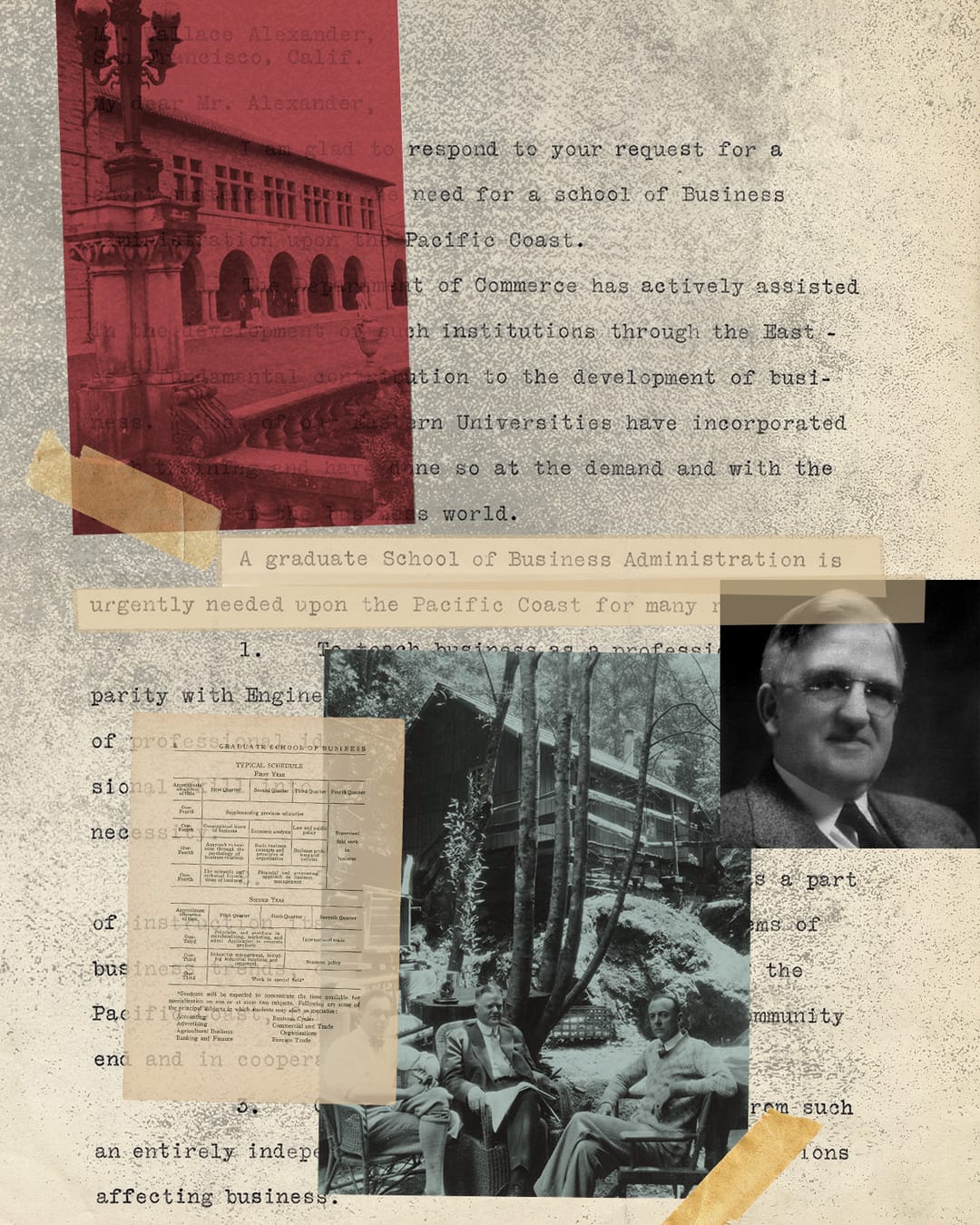
At a gathering of business executives at the Bohemian Grove, Secretary of Commerce Herbert Hoover (Stanford Class of 1895) proposes establishing a graduate school of business at Stanford.
1924
“A graduate School of Business Administration is urgently needed upon the Pacific Coast,” Herbert Hoover wrote to one of Stanford’s trustees in 1924. He proposed raising $50,000 to launch the new school “experimentally for a period of five years.”
GSB Archives
GSB Archives | First illustration by Hello Von
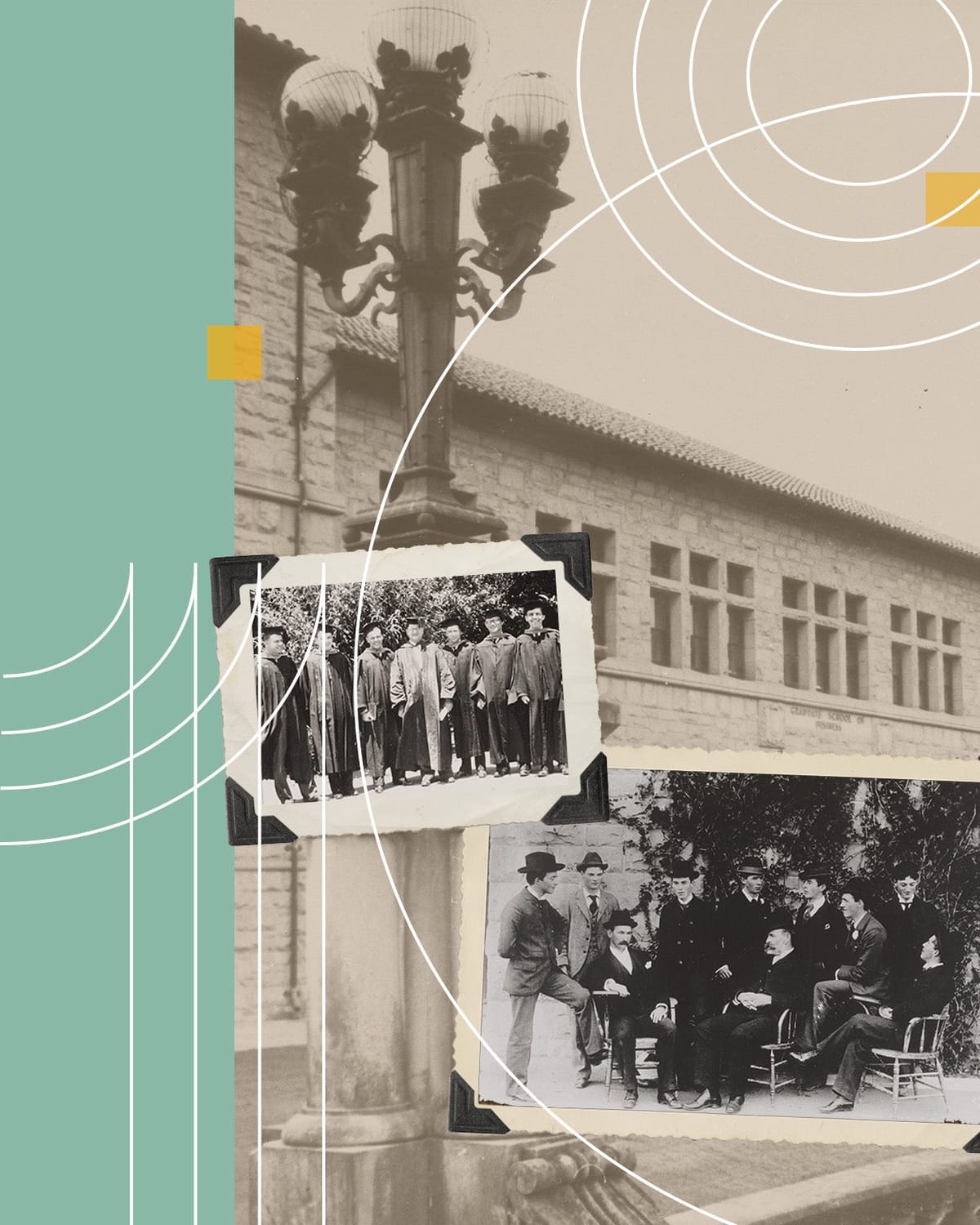
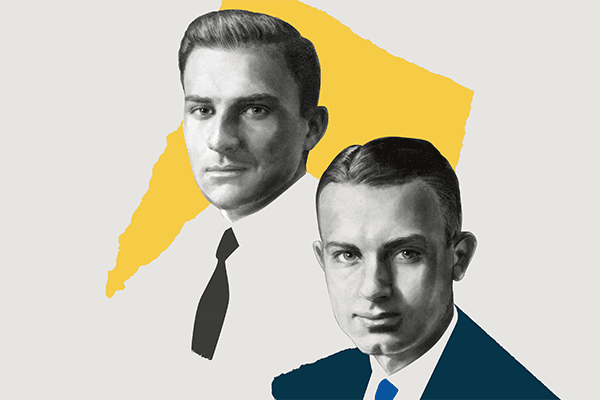
Charles Harold Overfelt and Melvin Sanguinetti, MBA ’27, become the first graduates to receive degrees from Stanford GSB.
16
Total MBA students
4
Total faculty members
Scroll or drag to see all
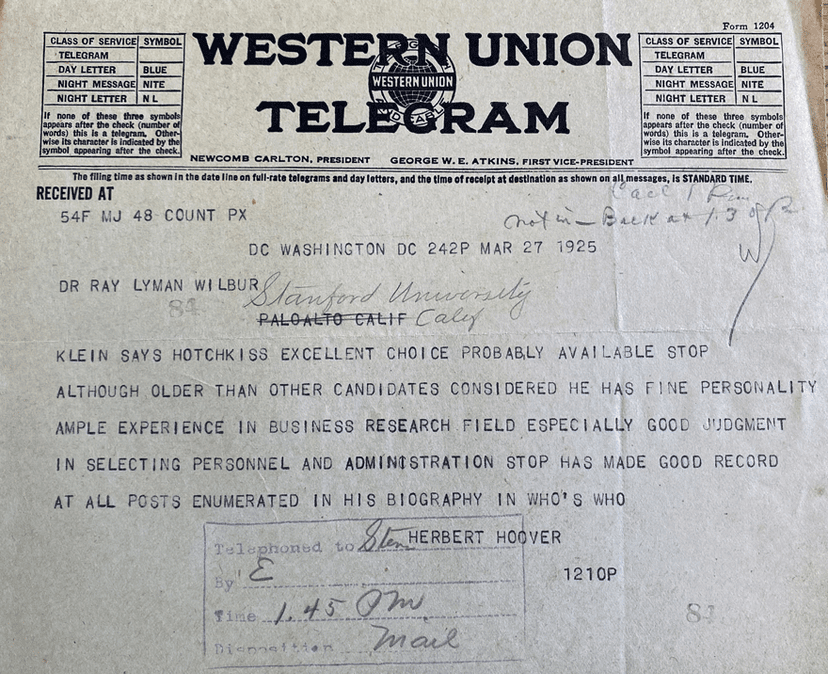
In a telegram to Stanford’s president in early 1925, Herbert Hoover approved of appointing Willard Hotchkiss as dean, praising his “fine personality,” “ample experience,” and “especially good judgment in selecting personnel.”
0
Graduate schools of business west of Cambridge, Massachusetts before 1925
$375
Annual cost of attending Stanford GSB in 1925–26
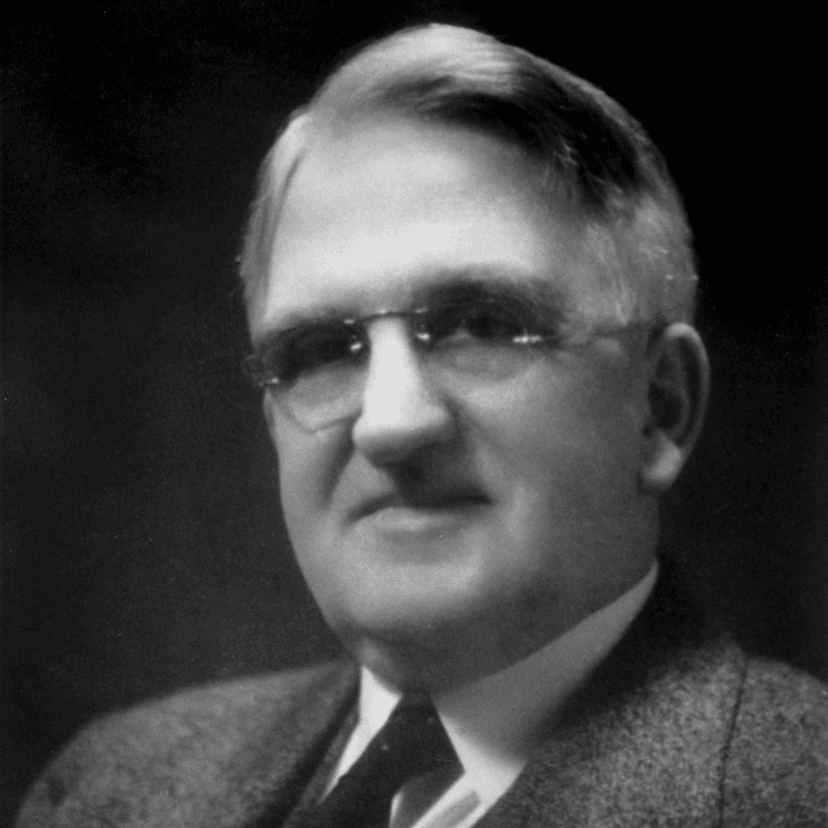
Willard Hotchkiss, who had co-founded business schools at Northwestern University and the University of Minnesota, becomes the first dean.
The school adopts a broad leadership-oriented curriculum instead of focusing on specialization.
“Without overlooking the purpose of preparing students for immediate service after graduation, it will be the chief concern of the School to develop qualities of mind that will make for continuous growth in capacity for leadership. To this end, disciplinary aims will be considered essential; informational aims will be incidental.”
The GSB curriculum covered accounting, economic analysis, marketing, management, and the geographical and psychological aspects of business.
The school’s first faculty members were Eliot Mears, professor of geography and international trade; Victor Pelz, professor of economics; and Edward Strong, professor of psychology.
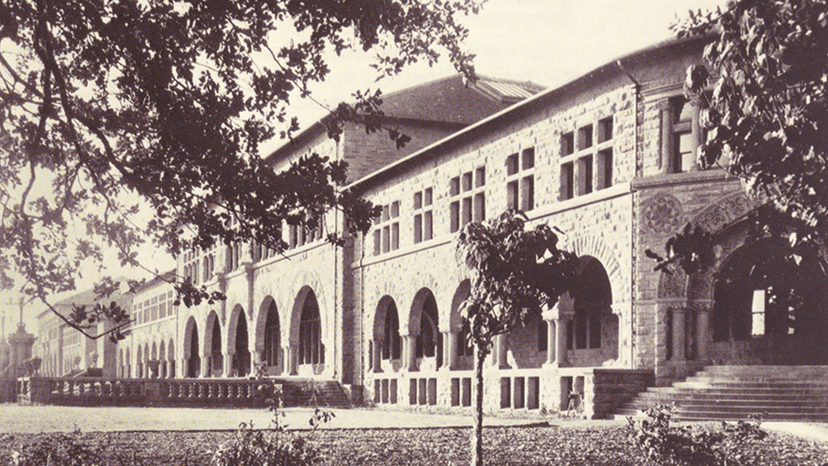
On October 1, Stanford Graduate School of Business opens.
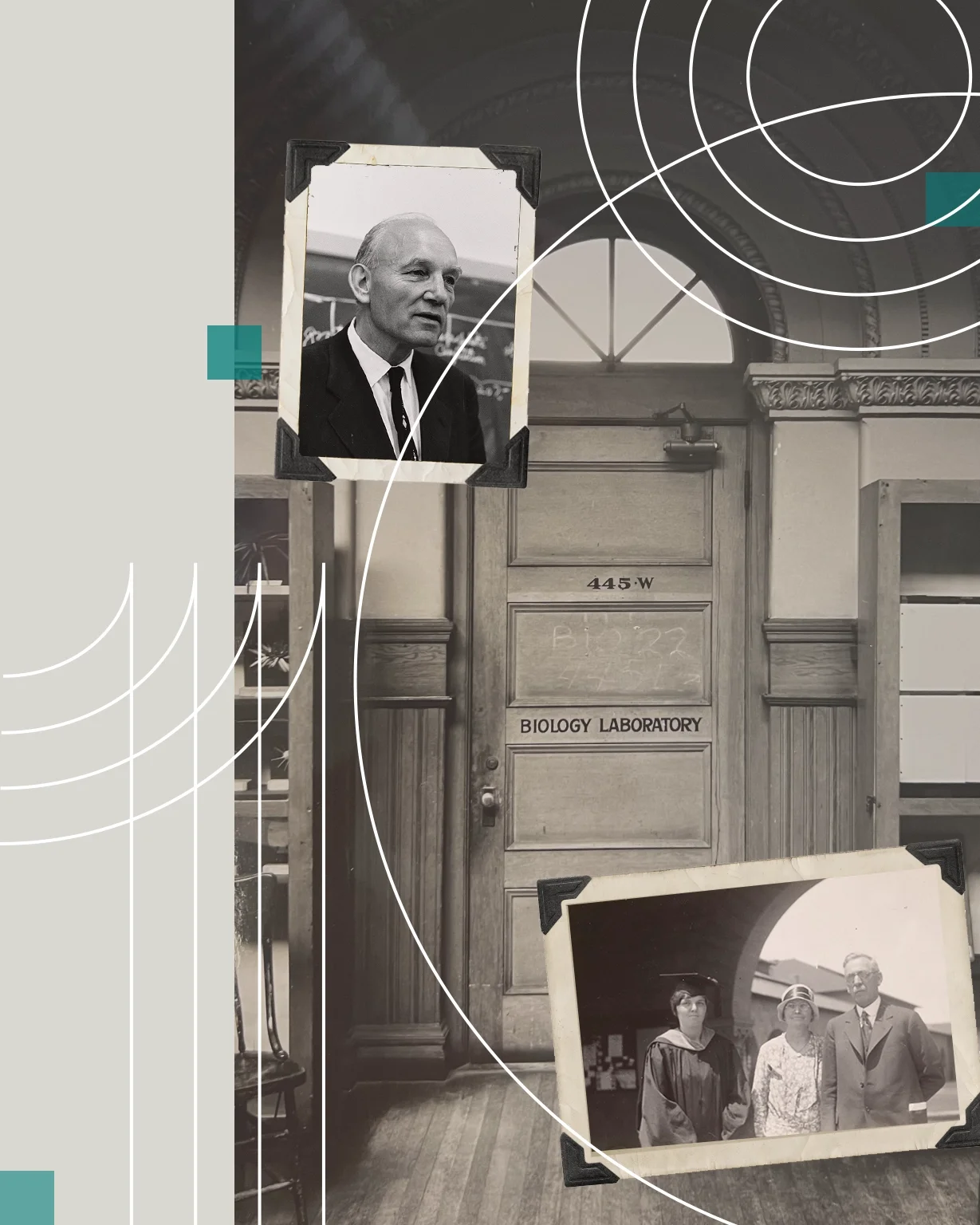
When the GSB opened, its two classrooms shared the first floor of Jordan Hall with the biology department. One faculty member recalled, “There was a persistent odor of dogfish in the halls, coming from the biology labs.”
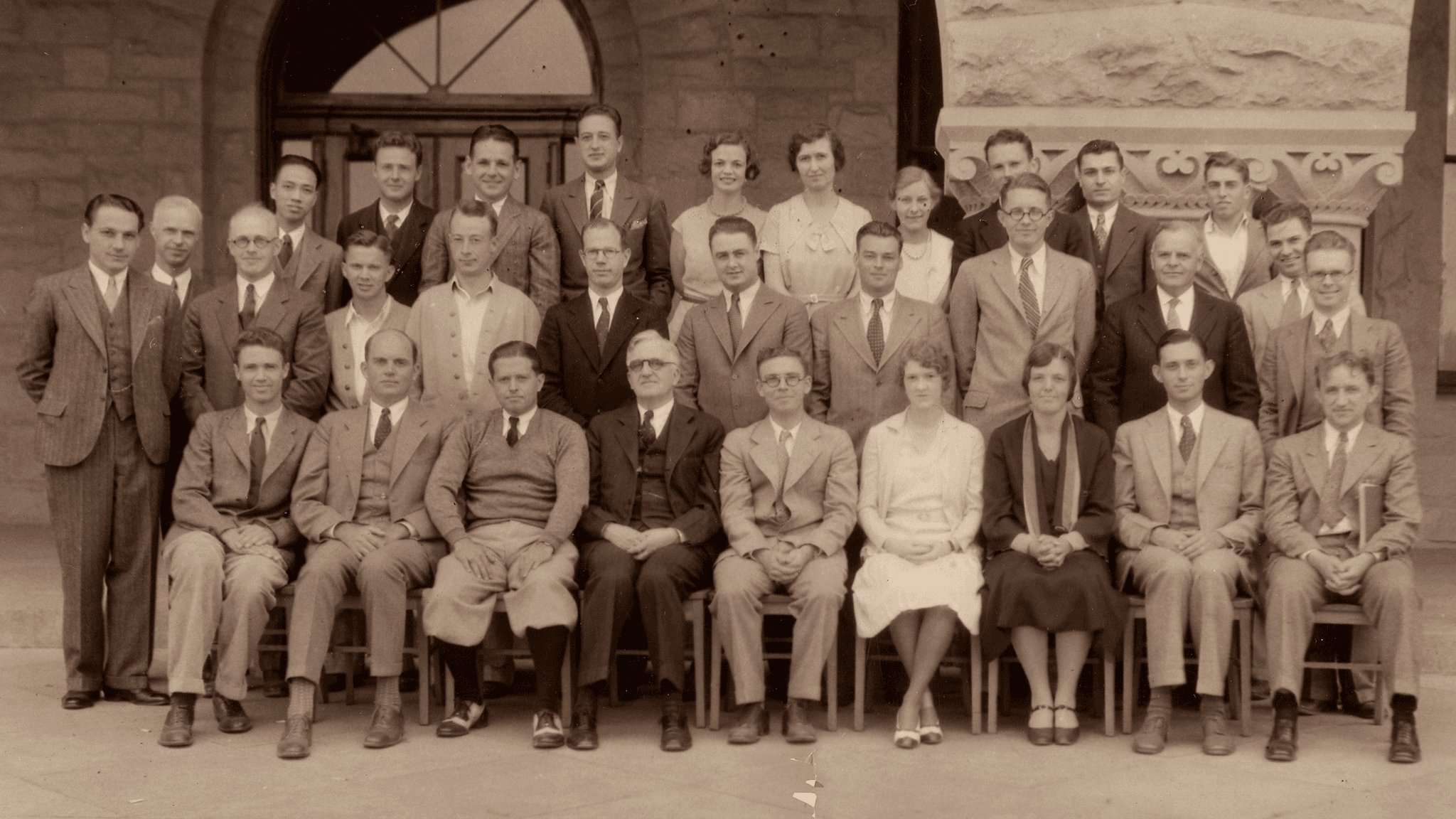
Lillian C. Owen becomes the first secretary of Stanford GSB, functioning as admissions officer, registrar, purchasing officer, information officer, counselor, and “mother hen.”
Charles Harold Overfelt and Melvin Sanguinetti receive MBAs, the only graduates in the inaugural class.
The stock market crash of 1929 and the resulting Great Depression had an enormous impact on the school, shaping its curriculum for the next 30 years.
In The U.S.
On October 24, 1929, shares on the New York Stock exchange lost more than $14 billion in value in a single day.
Teachable Moments
When the first students arrived at Stanford GSB in October 1925, the notion of a professional school for management training was still relatively new, as was the pedagogy surrounding it. A broad, balanced approach would set the school on the path it would follow over the next century as it shed its image as a regional upstart and became recognized as an innovator.
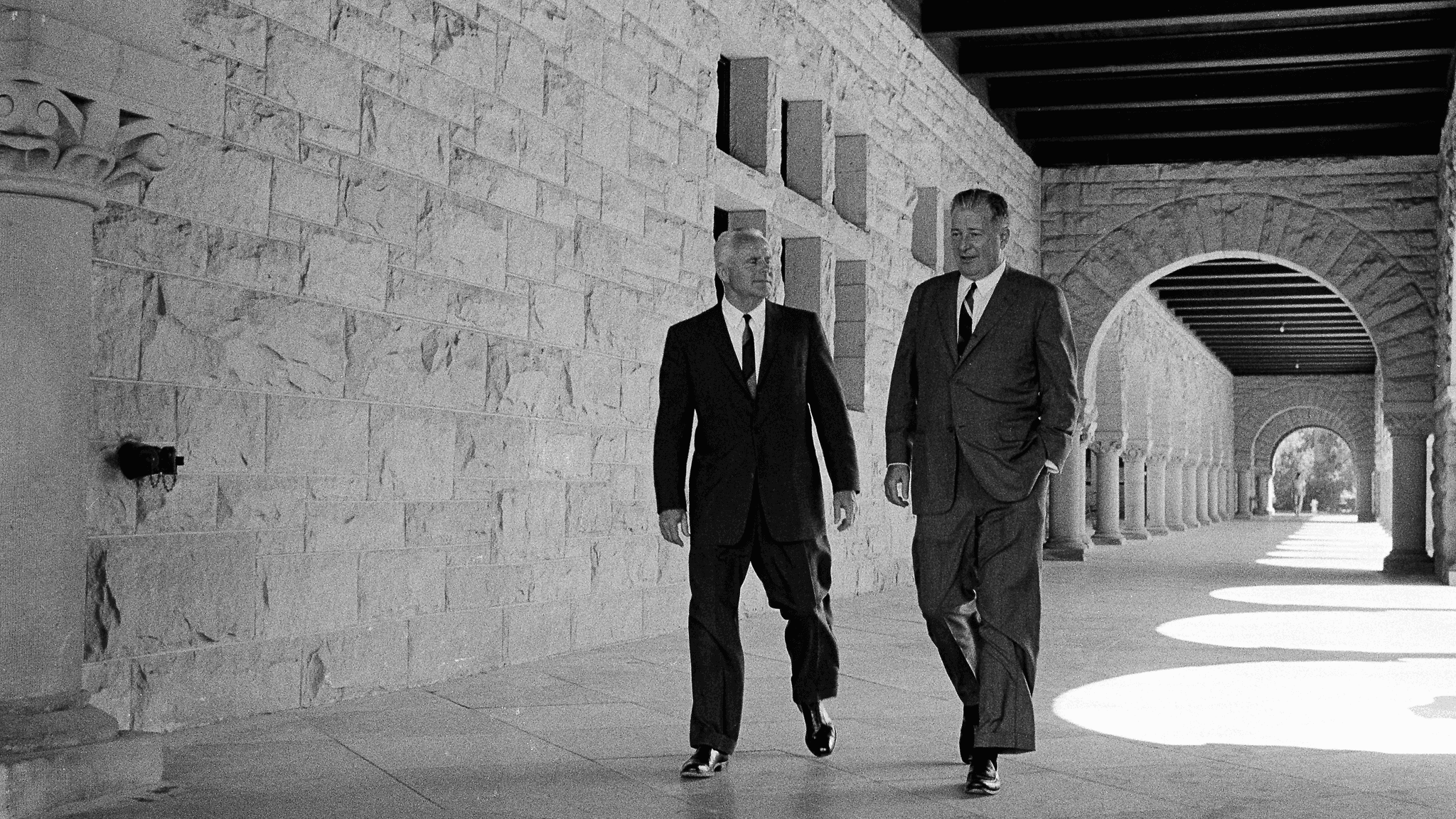
Pioneers
Meet the Stanford GSB community members who went first, blazed trails, and broke barriers. From Gertrude Elisabeth Benedict and Helen Elizabeth Carpenter, the first female MBAs, to Andrew Howard III and the Martin sisters, the school’s first African American grads, these pioneers paved the way for future generations. And read about more Stanford GSB “firsts,” including the first graduates, first professors, and alums who have led the way in business, sports, and space.
GSB Archives
GSB Archives | First illustration by Hello Von
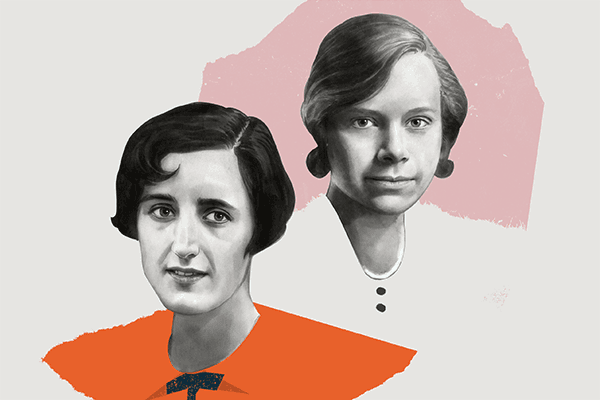
Gertrude Elisabeth Benedict and Helen Elizabeth Carpenter, MBA ’30, were the first women to receive degrees from Stanford GSB.
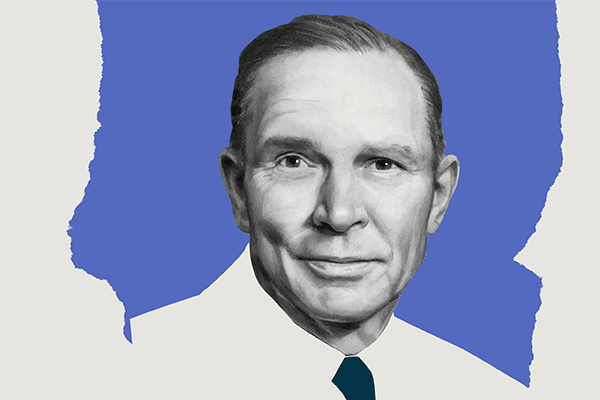
Harrison Val Hoyt, PhD ’31, received the first doctoral degree.
514
MBA degrees to date
2
PhD degrees to date
Scroll or drag to see all
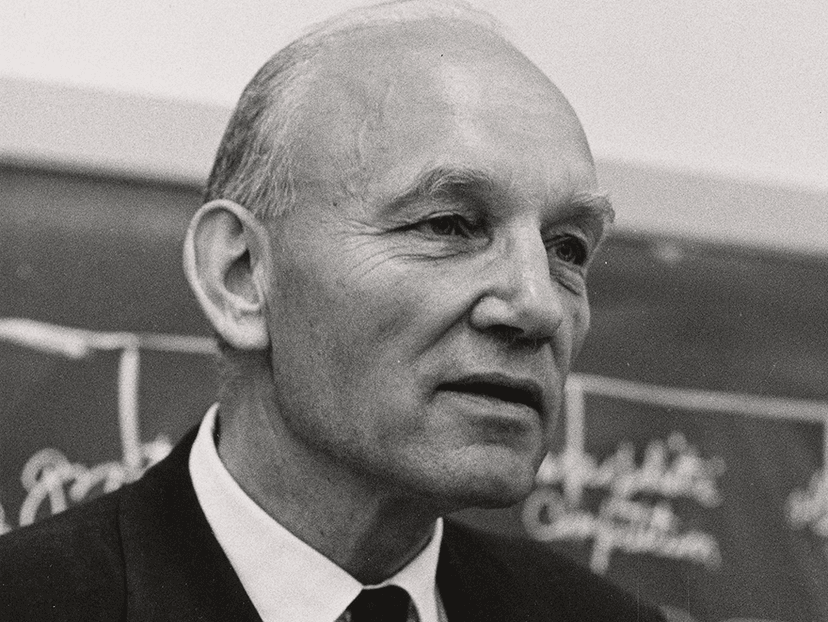
Economics professor Theodore “Ted” Kreps joined the GSB faculty in 1930. Known for challenging students’ assumptions, Kreps earned a reputation as “the conscience of the business school.”
“I am essentially a tugboat. My job is to get the big ships out in the channel with their engines running.”
— Theodore Kreps, 1962, reflecting on 32 years of teaching future business leaders
In 1977, Stanford GSB established the Theodore J. Kreps Professorship under a grant from the IBM Corporation and also set up the Theodore J. and Esther E. Kreps Fellowship Fund.
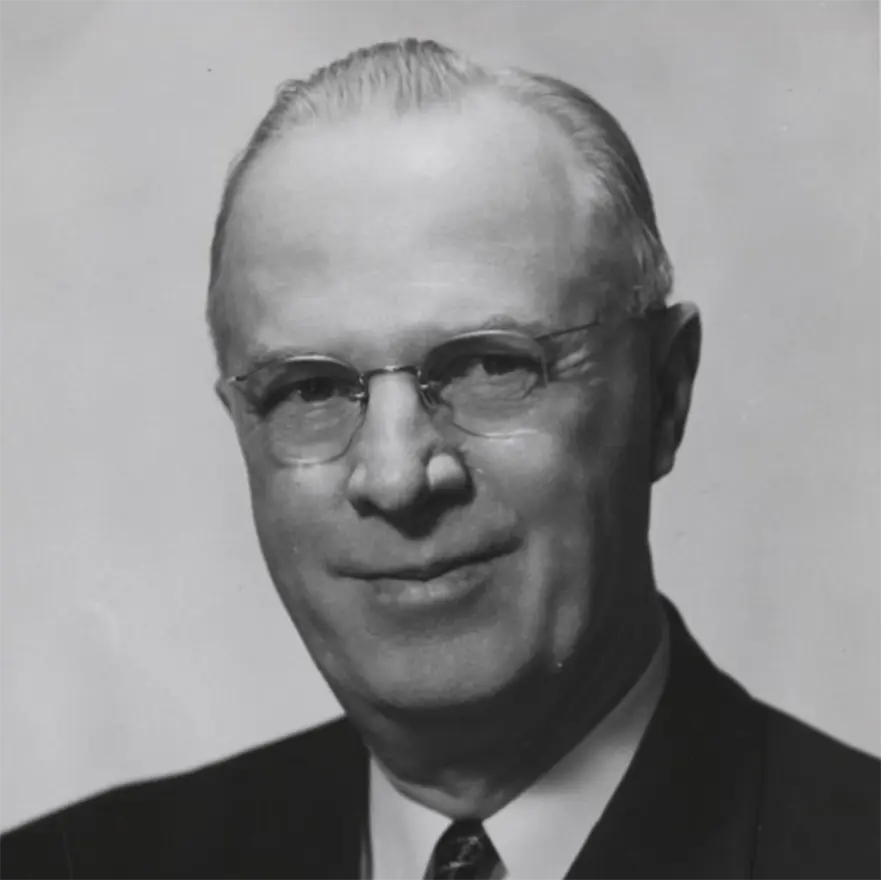
J. Hugh Jackson, a former Harvard Business School professor, becomes dean. His 25-year tenure is the longest in the school’s history.
In the 1930s, Dean Jackson began the practice of recruiting prominent professionals as “consulting professors” to lecture and advise students. Jackson unsuccessfully asked Louis B. Mayer and Walt Disney to sign on.
The first alumni clubs form in the San Francisco Bay Area and Los Angeles.
$1,390
Average starting salary for recent MBA in 1939
The Business School Club sponsored a weekly 50-cent dinner and guest speaker program for students and faculty.
The first PhD is awarded to Harrison Val Hoyt, who later became dean of business schools at Brigham Young University and Oregon State University.
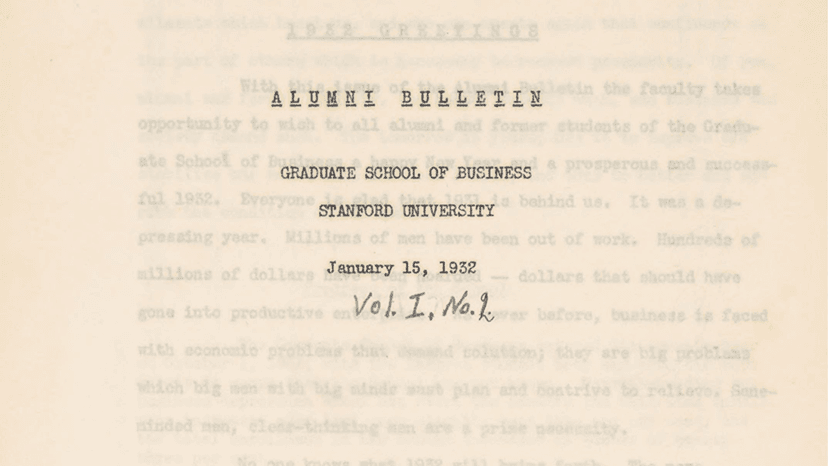
The first issue of the Alumni News Bulletin is published, a 12-page mimeograph.
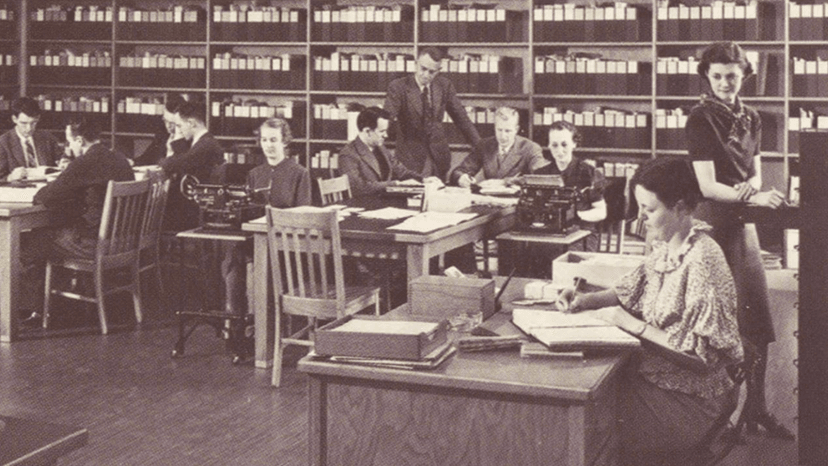
Stanford GSB library opens in Jordan Hall with a collection of 1,000 books.
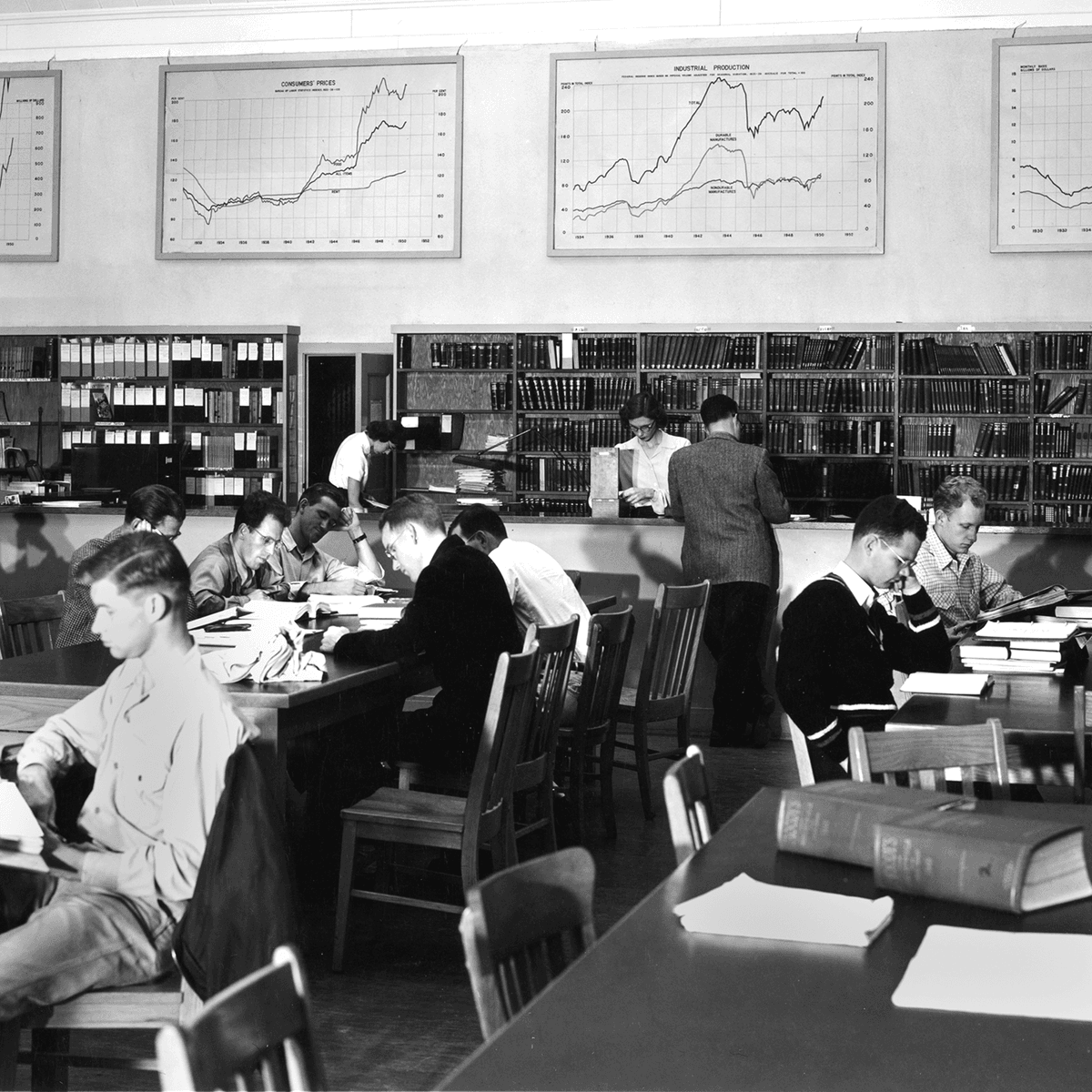
The library installed a projector to show slides and “opaque objects such as charts, forms, and book pages.”
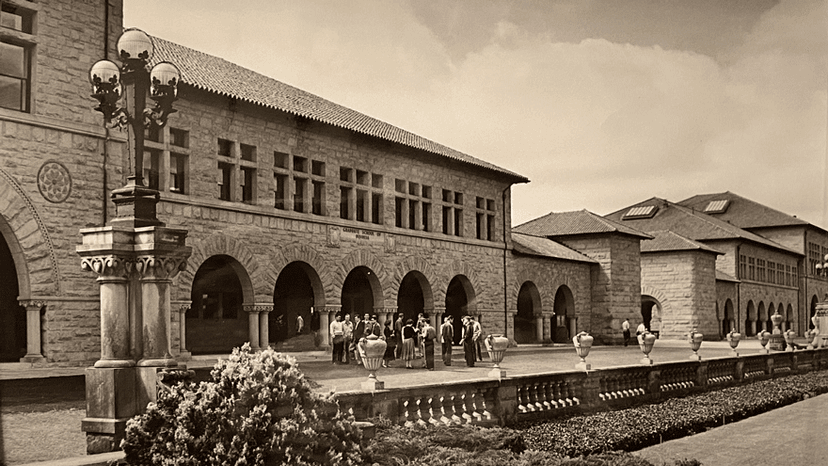
Stanford GSB moves into the recently remodeled Assembly Hall, where it will stay for nearly 30 years.
$189,000
Project cost
19,200
Square feet
5
New classrooms
Shelf Discovery
When the GSB Library opened in 1933, it occupied one room and kept 1,000 volumes on its shelves. As of 2024, it occupied a four-story building and had 180,000 items, including digital books and journals, in its catalog. It held 116 terabytes of data in its secure data storage and analysis platform and its staff fielded hundreds of questions from students and researchers annually (26,872 since 2016, to be precise).
GSB Archives
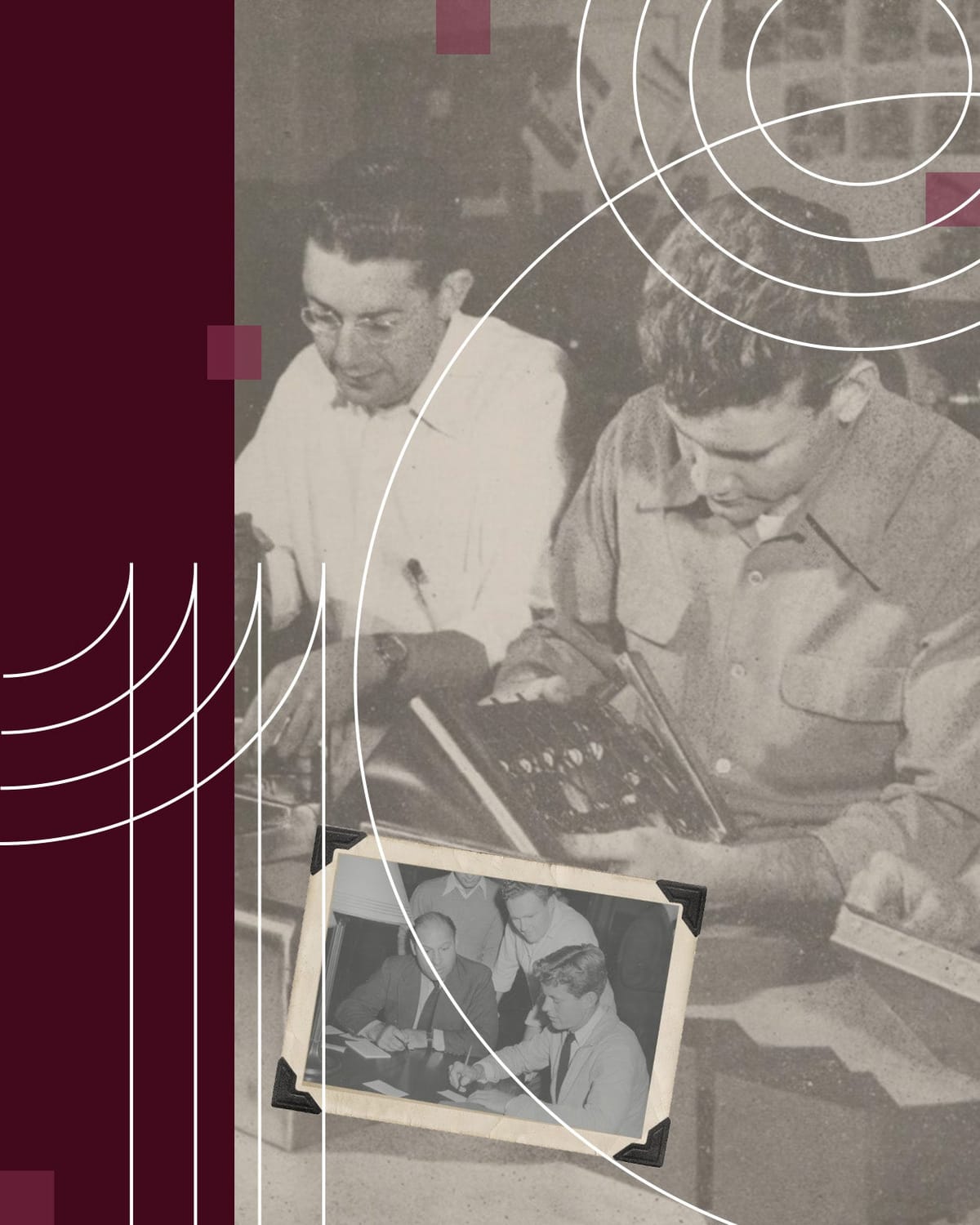
Stanford Graduate School of Business granted its first PhD in 1931. Since then, more than 1,100 students have earned doctoral degrees from the school. Here’s a look at how the PhD program has expanded over the years and how its graduates have taken research and teaching positions across the United States and the world.
GSB Archives | First illustration by Hello Von
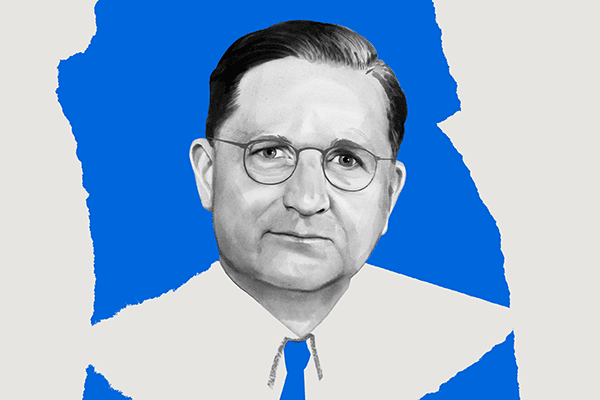
George Dowrie retires and becomes the first emeritus professor at Stanford GSB.
1.6k
MBA degrees to date
12
PhD degrees to date
Scroll or drag to see all
As the U.S. drew closer to entering World War II, the GSB retooled its curriculum. New programs to prepare men and women for work in war industries were implemented.
“The faculty will do everything possible to advance the cause of democracy in this manner.”
— Dean J. Hugh Jackson
In The U.S.
United States entered World War II in 1941.
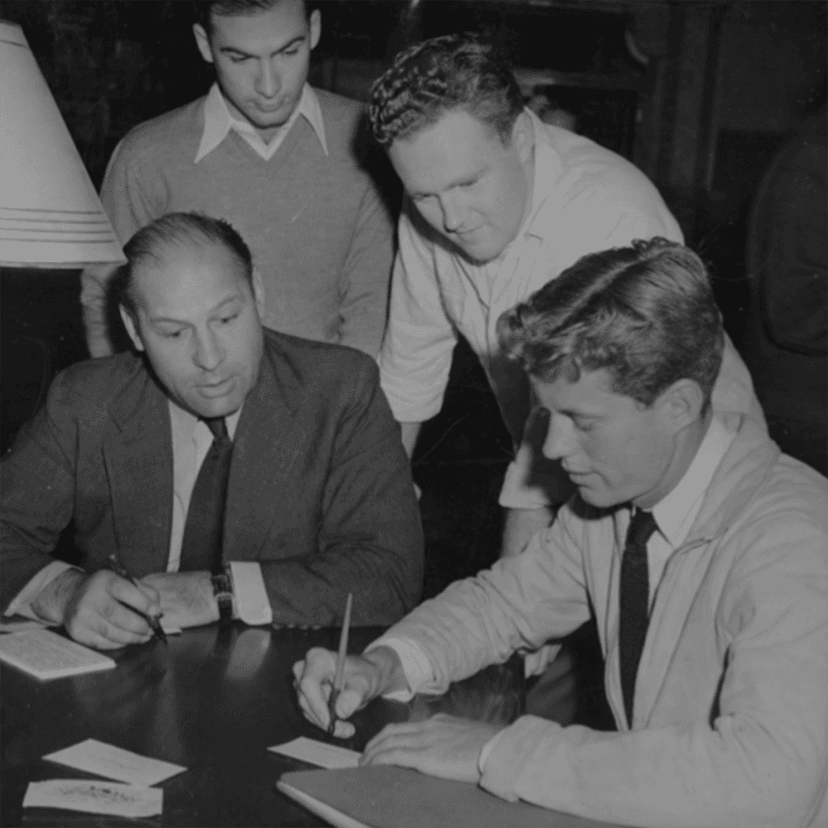
John F. Kennedy audited classes at Stanford GSB in the fall of 1940. The 23-year-old joked to the Stanford Daily that he’d come to Palo Alto to check out the climate. Ted Kreps, one of the future president’s instructors, said JFK “would have come out with an A” if only he had returned after the winter break.
MBA enrollment dips to a wartime low of 23 students. The course catalog shrinks to four pages.
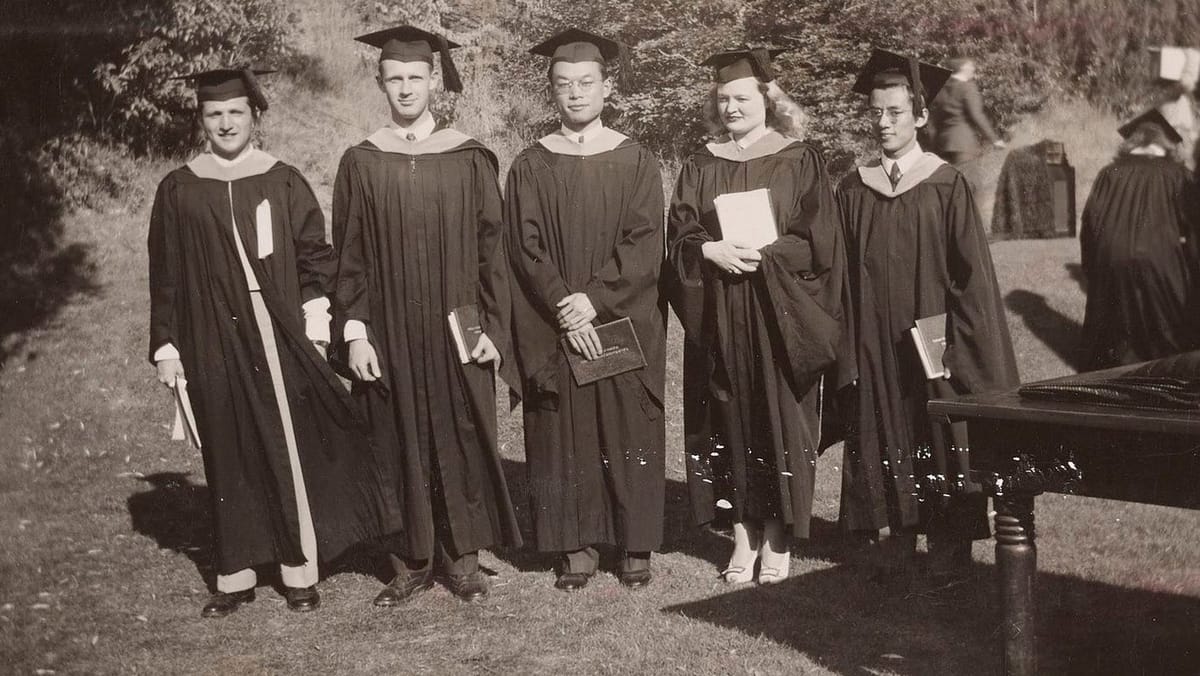
The Stanford Business School Alumni Association (known as the Stanford GSB Alumni Association today) is organized to bring together the 700 graduates the school has in 1946.
The new alumni association holds its first postwar annual dinner in July.
In The World
WWII ends in 1945
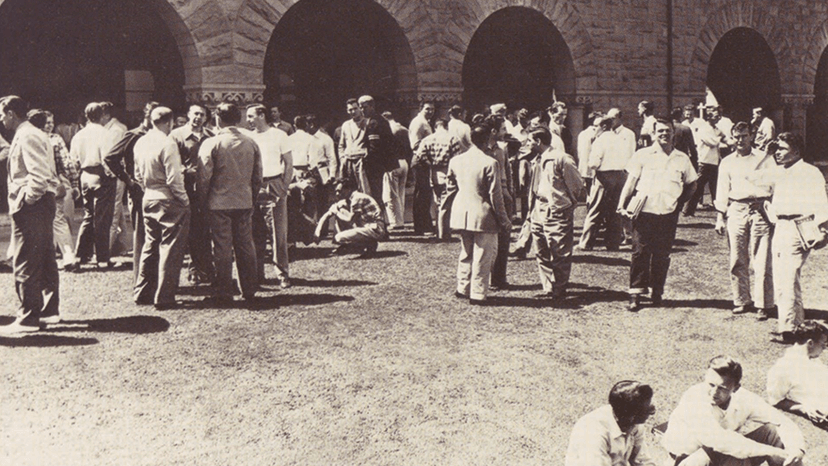
Enrollment skyrockets as soldiers return home, peaking at 572. Ninety-three percent of students are registered under the G.I. Bill.
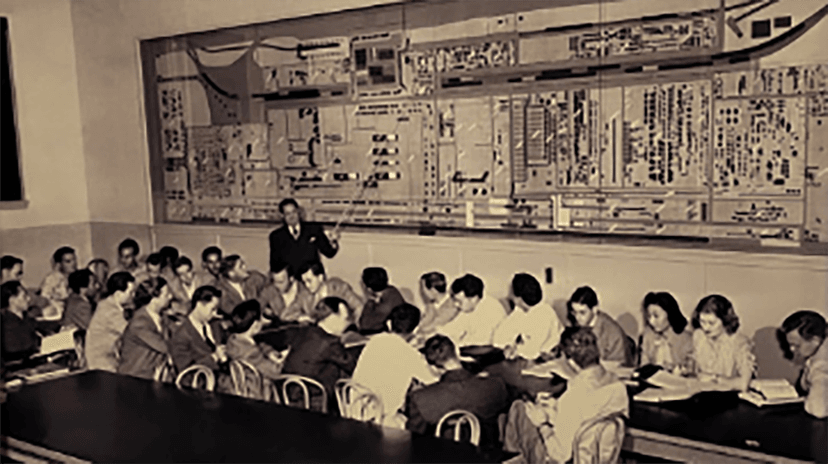
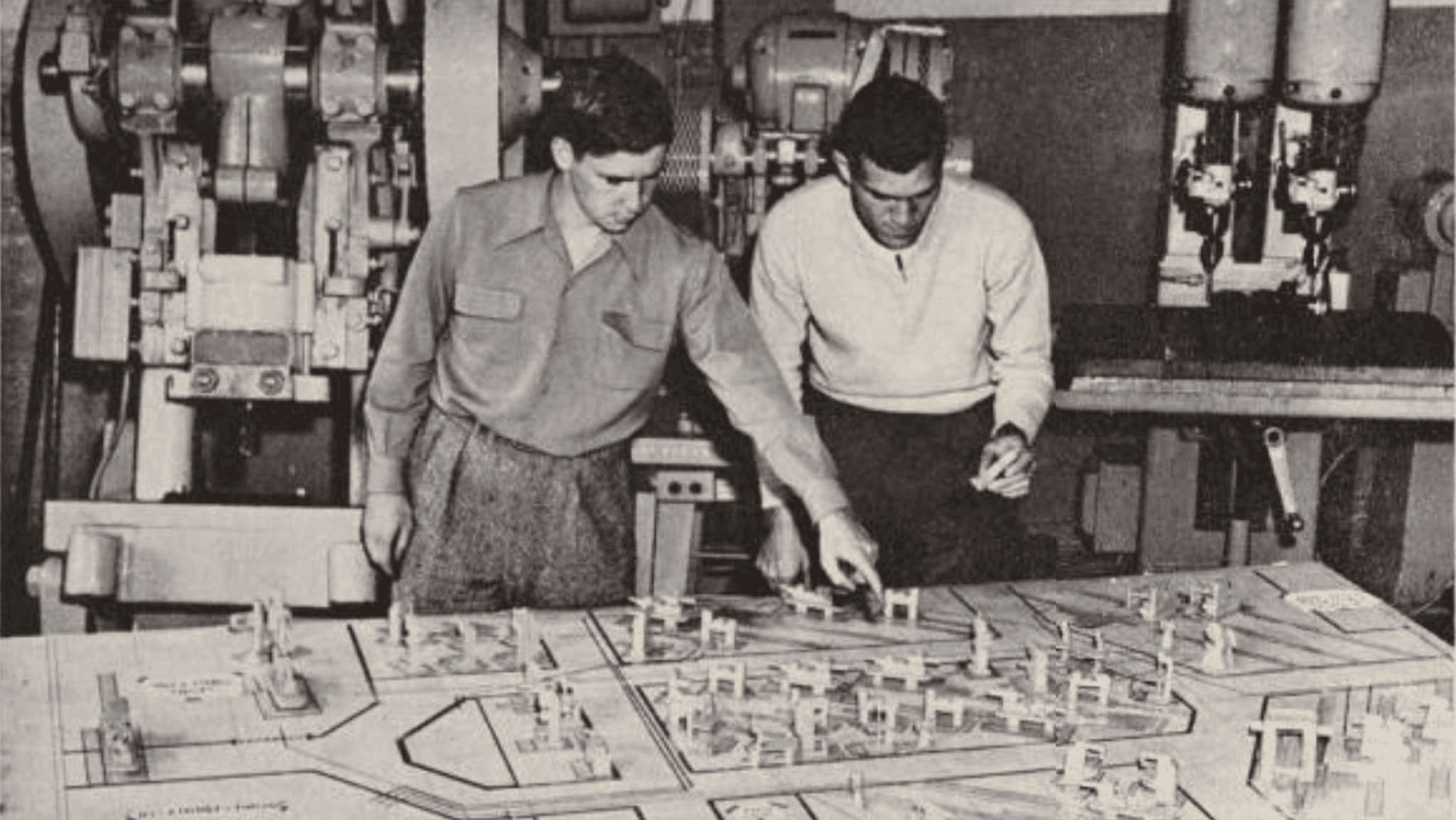
Stanford GSB opens its Industrial Laboratory, where students get hands-on lessons in machining and production.
Heyday of American Manufacturing
In Stanford GSB’s initial decades, manufacturing was a top sector for grads. Classes reflected this trend. The first MBA students could specialize in industrial management; students in the late 1940s took production courses in the school’s new industrial laboratory; Manufacturing I and II were required for all MBA students in the 1960s. For a while, the factory reigned supreme.
A Century of Leadership
Stanford GSB’s first dean, Willard Hotchkiss, launched the school in 1925 with just 16 students. Jacob Hugh Jackson oversaw the school for nearly two decades, while Ernest C. Arbuckle is credited with creating the modern GSB by expanding enrollment and faculty. Arjay Miller served as dean from 1969 to 1979, advocating for business to work for the public good. More recent deans oversaw moves to new buildings and expansions in curriculum and research. And in June 2025, the GSB welcomed its 11th dean, Sarah Soule.
GSB Archives
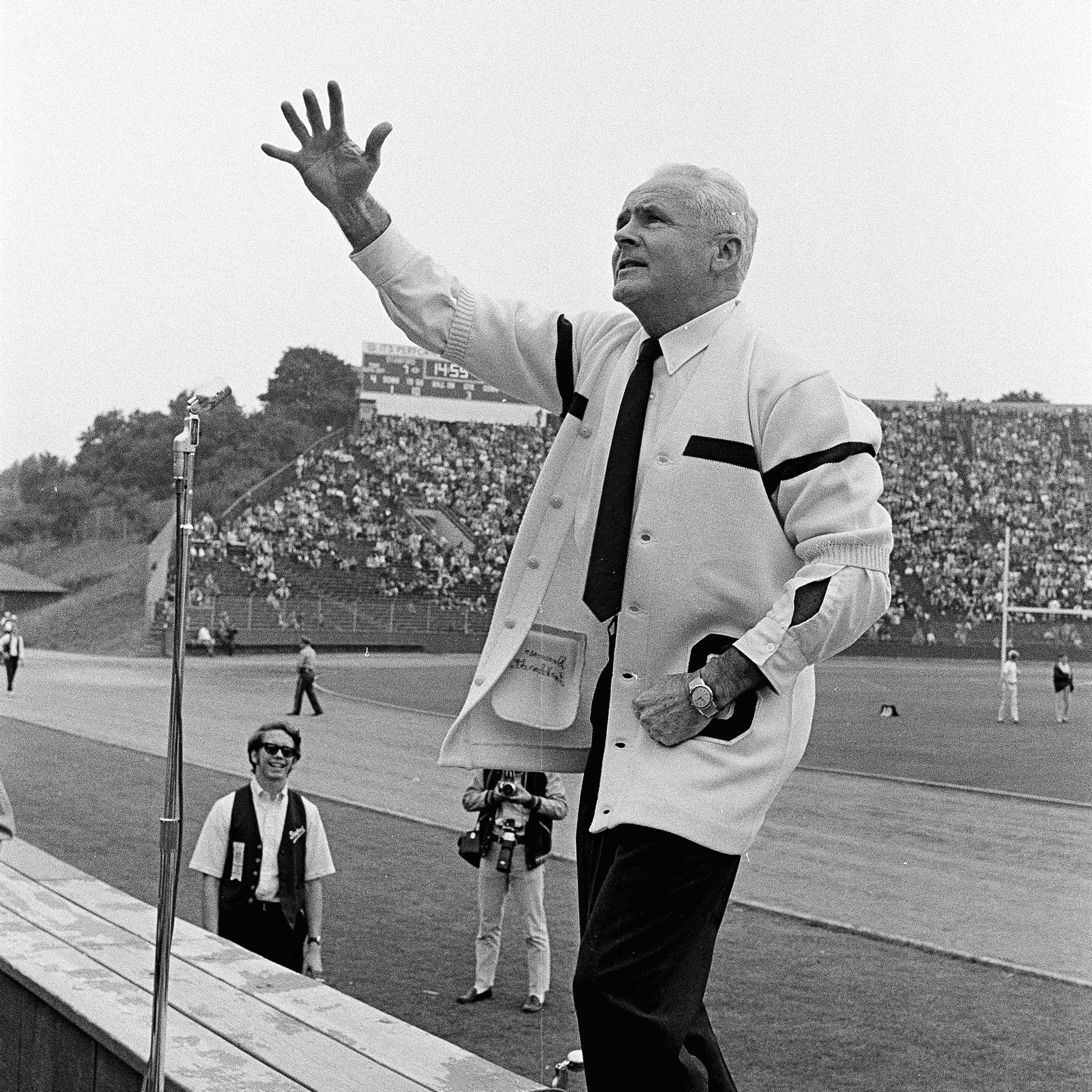
GSB Archives | First illustration by Hello Von
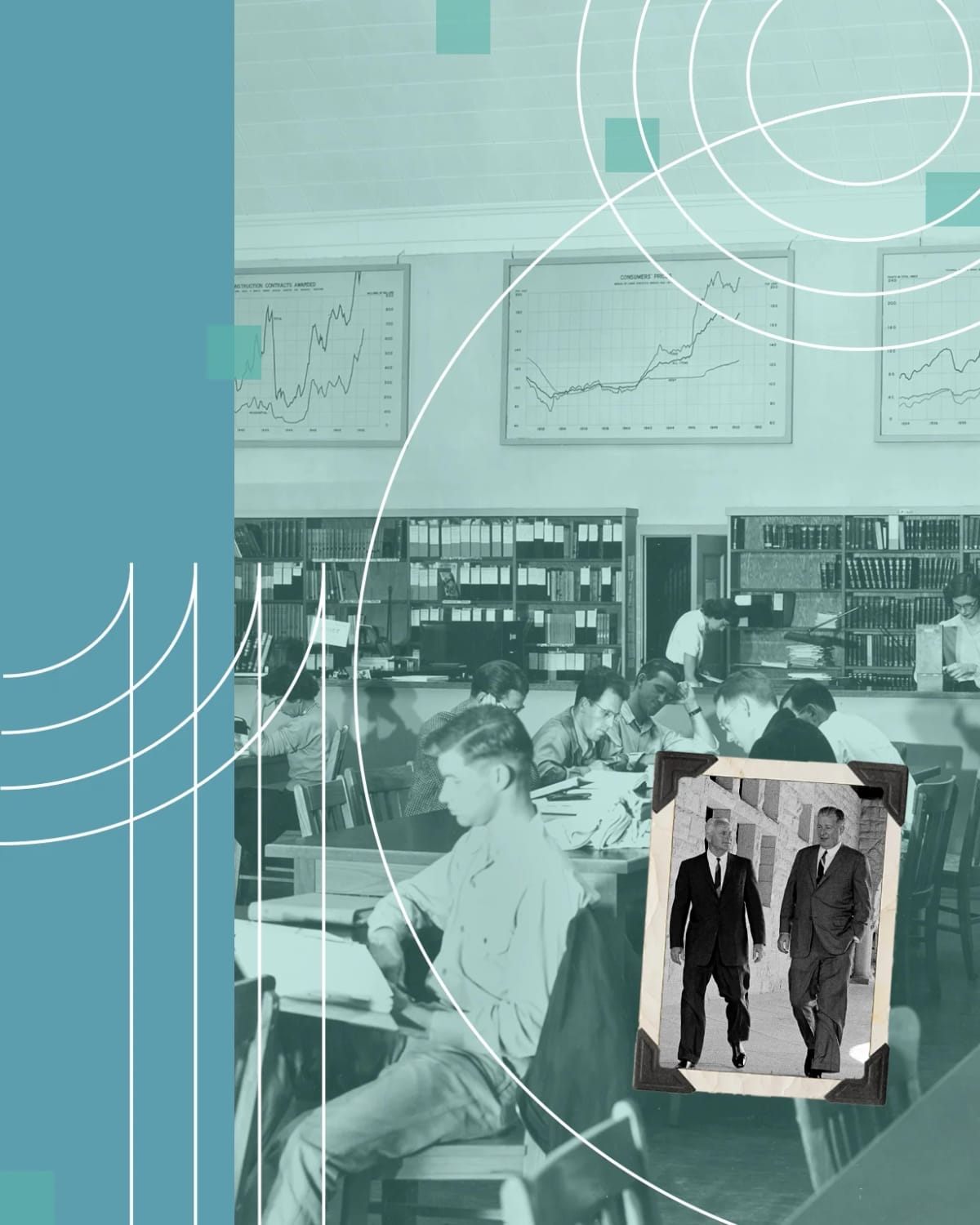
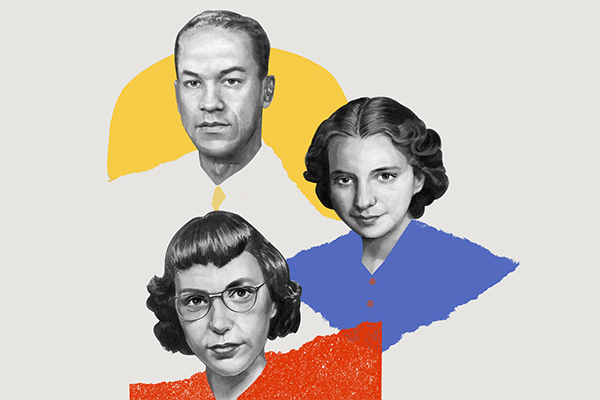
Andrew Howard III, Rose Martin, and Helen Martin of the class of ’53, become the first African American students to be awarded degrees from Stanford GSB.
3.5k
MBA degrees to date
20
MS degrees to date
362
SEP degrees to date
19
PhD degrees to date
3.9k
Total degrees to date
Scroll or drag to see all
The Executive Development Program (renamed the Stanford Executive Program in 1966) begins with an eight-week residential course for 37 students.

The Burroughs Adding Machine Company demos 26 of its models in the Stanford GSB lounge.
The University Board of Trustees approves creating the Stanford Business School Fund.
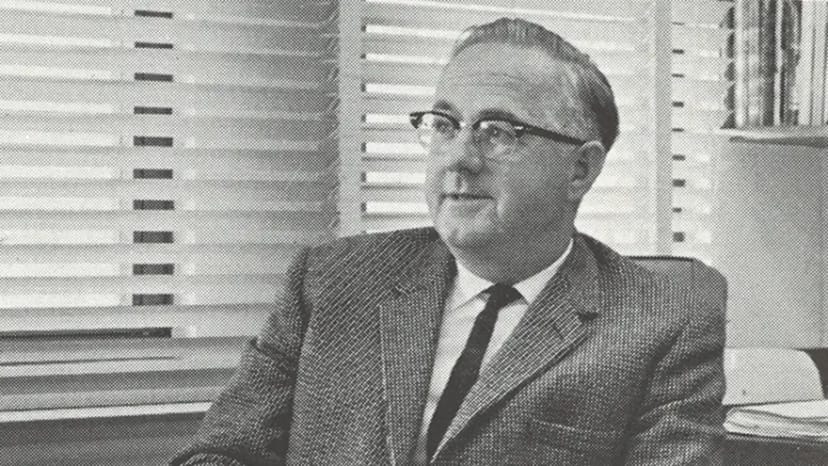
Carlton A. Pederson, a professor of management at the GSB, becomes acting dean.
When Dean Jackson retires after 25 years, the school’s library is named the Jackson Library in his honor.
The Alfred P. Sloan Foundation funds the Stanford Program in Executive Management, a mid-career master’s program, later known as the Stanford Sloan Program and now MSx.
IBM gives the school a three-year, $25,000 grant to hire a professor of data processing.
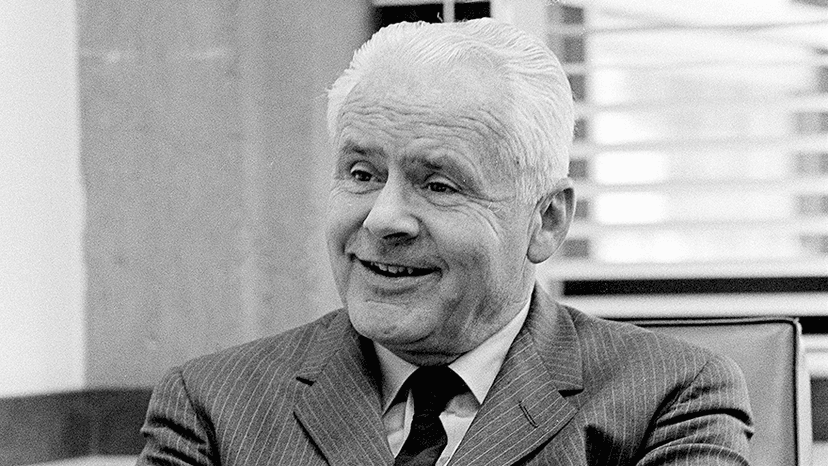
Ernest C. Arbuckle, MBA ’36, a former executive at W.R. Grace and Co., Standard Oil of California, and Wells Fargo, becomes dean.
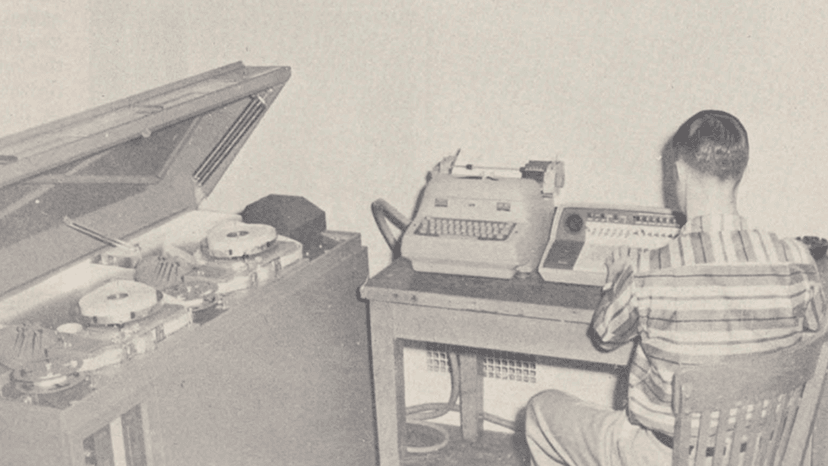
The GSB gets its first computer, an IBM Type 610. The school’s first computer class, Introduction to Electronic Data Processing, is taught in spring 1959.
“After a few hours of lectures, a student can sit down and operate the machine himself.”
— Alumni Bulletin
800 lbs.
Weight of the “mobile” IBM 610
By 1960, the Alumni Bulletin had stated that all Stanford GSB students “should learn that computers exist.” Case problems involving computers are introduced in classes.
GSB professor James Howell coauthors a critical report on the state of business education in America.
Dean Arbuckle creates the school’s Advisory Council.
The X Factor
In 1958, the first group graduated from what became known as the Stanford Sloan Program, a certificate program created to bring together future corporate leaders. Now known as the Stanford MSx Program, it has since evolved into a one-year, on-campus degree program with an expanded size and scope. Its strong sense of community has remained consistent over the years.
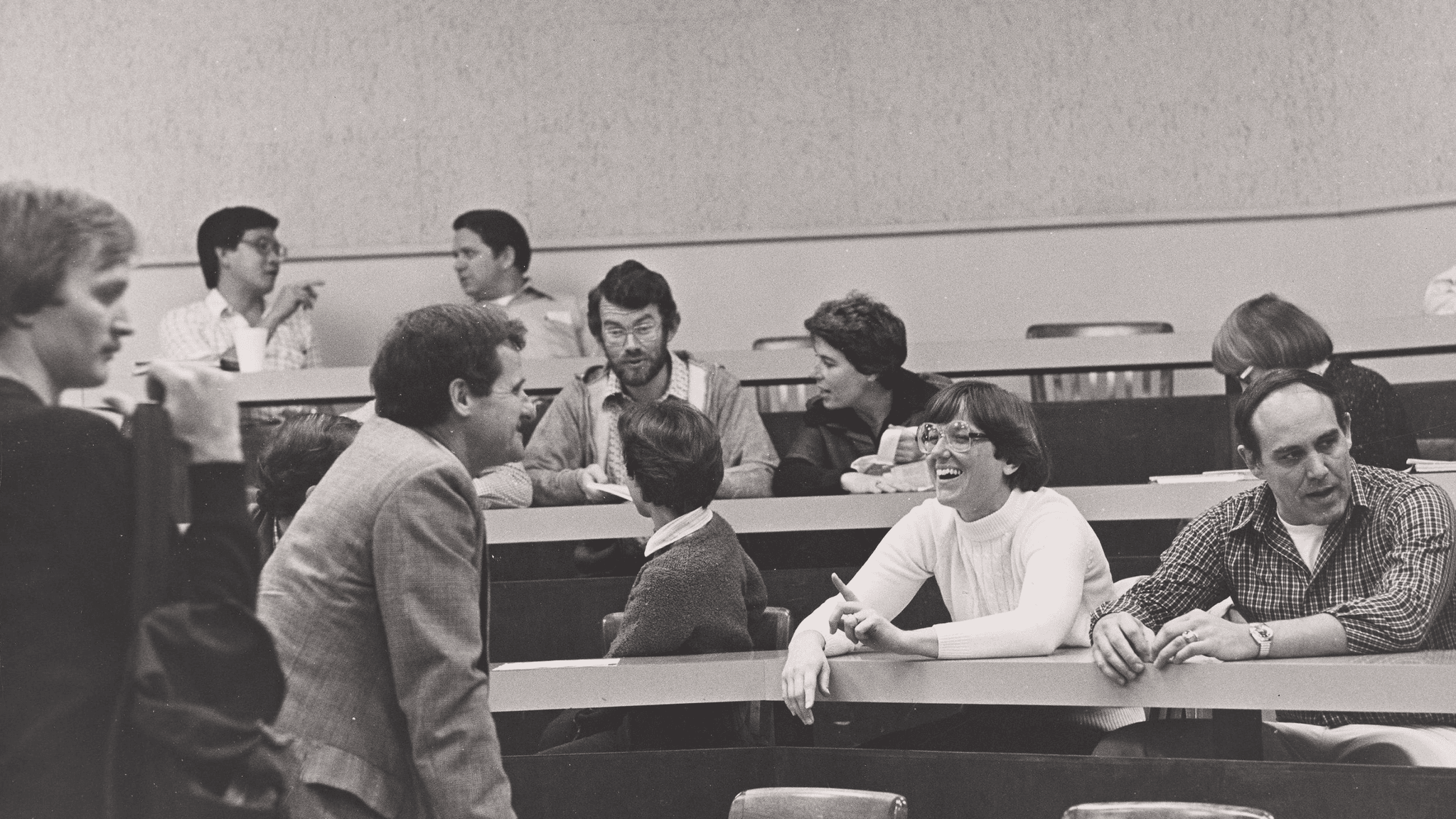
Hi, Tech
For its first few decades, Stanford Graduate School of Business was anything but high tech. That changed with the dawn of the Digital Age, as the faculty learned how to integrate computers into their teaching and research and increasingly tech-savvy students sought to stay ahead of ever bigger technological leaps. Click to download the details on nine decades of upgrades, from punch cards to PCs and vacuum tubes to GPUs.
GSB Archives
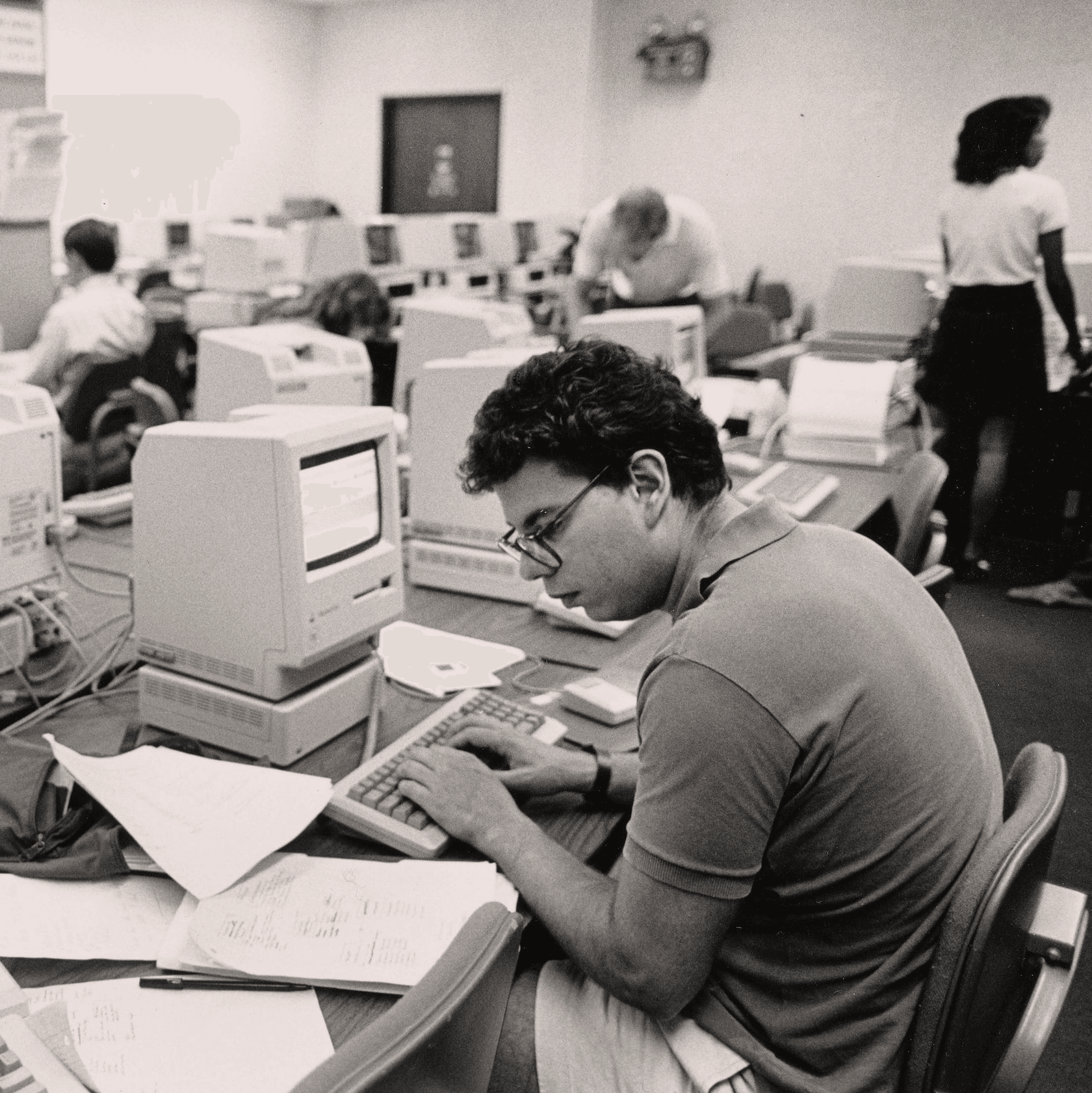
For over 70 years, the Stanford Executive Program (SEP) has hosted some 9,300 executives seeking new opportunities. The program emerged from the Engineering, Science and Management War Training initiative, established to address the evolving business landscape post-WWII. Its overwhelming success led Stanford GSB to include executive training as a permanent academic offering. Now, SEP inspires around 225 participants from 40 countries every year, empowering leaders professionally and personally.
Elena Zhukova

GSB Archives | First illustration by Hello Von
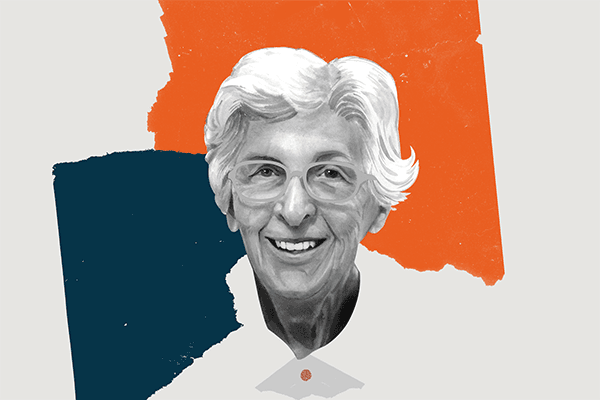
Persis Emmett Rockwood, PhD ’60, becomes the first woman to receive a doctorate from Stanford GSB.
5.7k
MBA degrees to date
200
MS degrees to date
1.1k
SEP degrees to date
81
PhD degrees to date
7.1k
Total degrees to date
Scroll or drag to see all
George Leland Bach started at Stanford as a visiting scholar in 1962, and he became a prominent faculty member until his retirement in 1983. In addition to being a popular teacher and renowned economist, Bach helped develop the “New Look” of business education in the 1960s and shaped the GSB’s ethos of “balanced excellence” during the 1970s.
“I can’t think of one person who had more of an impact on business education in the whole century,”
— Professor Charles Horngren
Ed Zschau, MBA ’63, PhD ’67, pays tribute to students who had to learn linear programming in a song titled “Do the L.P.” He performed it at the Spring Fling.
“Come on, baby, do the L.P. with me. We’re gonna pivot step day and night and optimize it out of sight!”

Spring Fling, a day of skits, sports, and socializing continued through the mid-’80s.
In The U.S.
United States enters enters the Vietnam War.
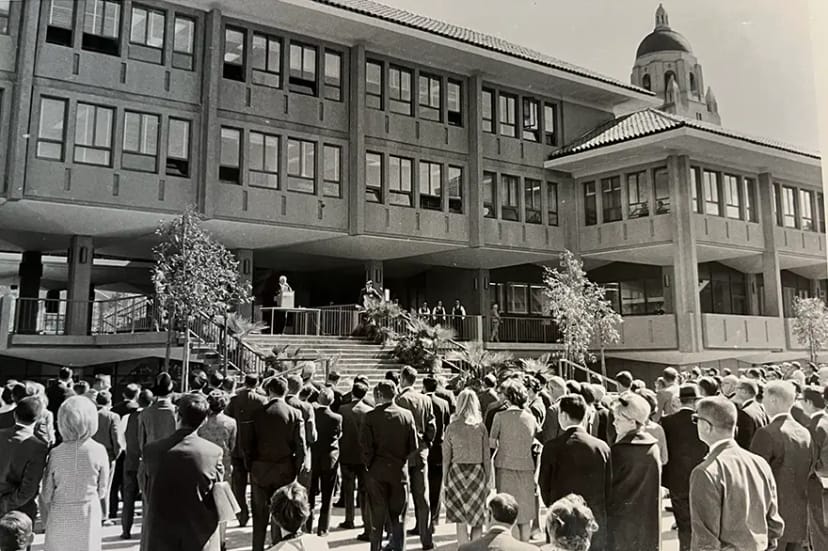
The GSB moves into a three-story building across from History Corner.
37
Classrooms
171,500
Square feet
$5.5M
Project cost
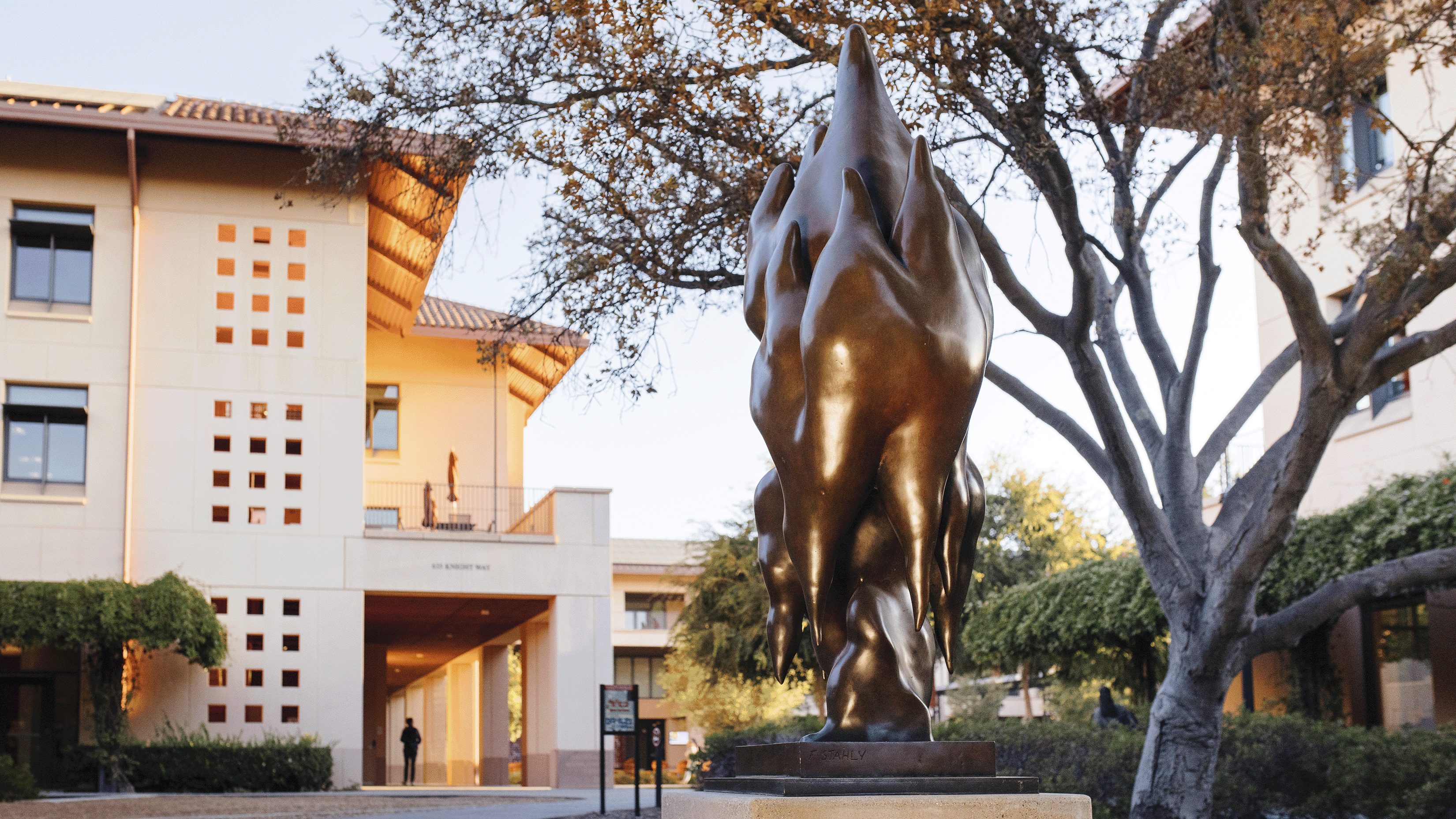
Since it was installed in 1966, The Flame Birds has been a focal point, meeting place, and Stanford GSB icon. The birds were hatched by François Stahly, a German-French sculptor celebrated for his expressionist, organic forms, who made a stop at Stanford as an artist-in-residence from 1964–65.
In 1968, Dean Arbuckle leaves the GSB, sticking with his philosophy that everyone should “repot” every 10 years or so. The term becomes a Stanford GSB buzzword. When Dean Miller steps down in 1979, he says it was “time to repot.”
“Repotting, that’s how you get new bloom. You should have a plan of accomplishment and when that is achieved you should be willing to start off again.”
— Dean Ernie Arbuckle
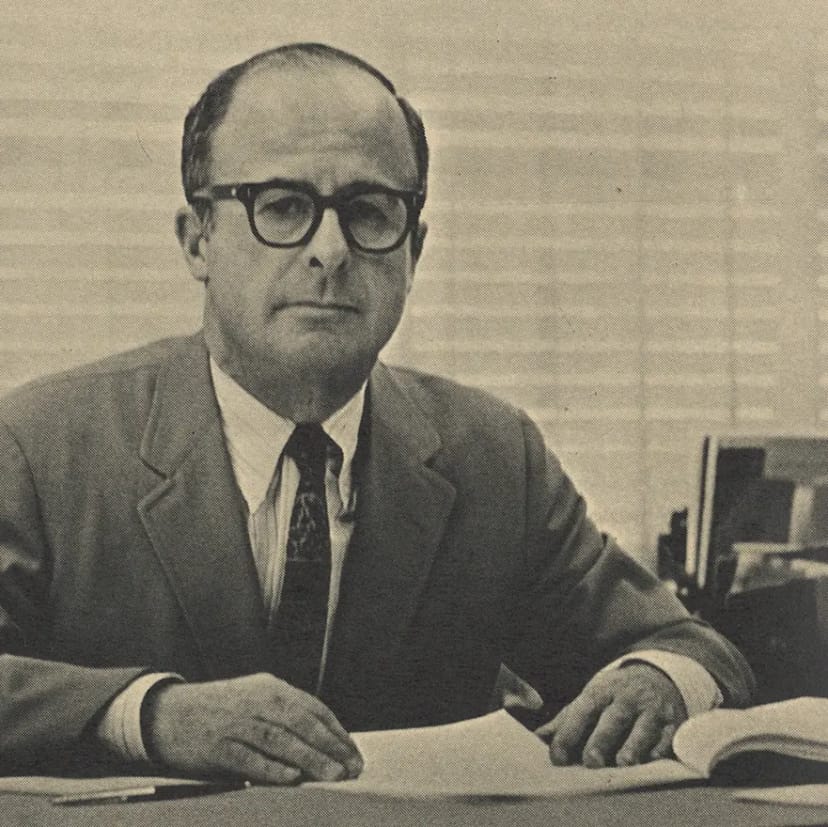
Samuel “Pete” Pond, MBA ’39, becomes acting dean.
Management and the Computer becomes a requirement for first-year MBAs. “We do not expect students to become super-programmers,” says Professor Norman R. Nielsen. “Rather, we expect them to understand the computer as a tool, a lightning-fast calculator with an instant memory which can help them arrive at business decisions.”
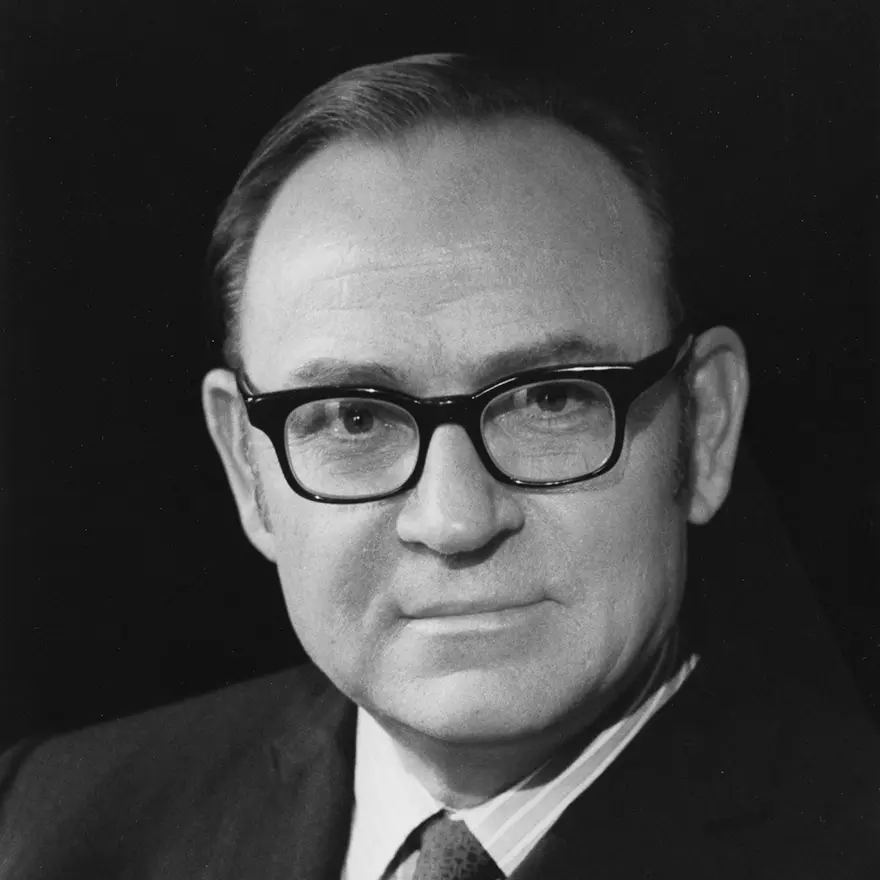
Arjay Miller, Ford Motor Company president and one of the company’s former “Whiz Kids,” becomes dean.
The library rolls out “automated computer printouts” of its periodical holdings. A two-week pre-enrollment class is introduced to prepare students for computer programming.
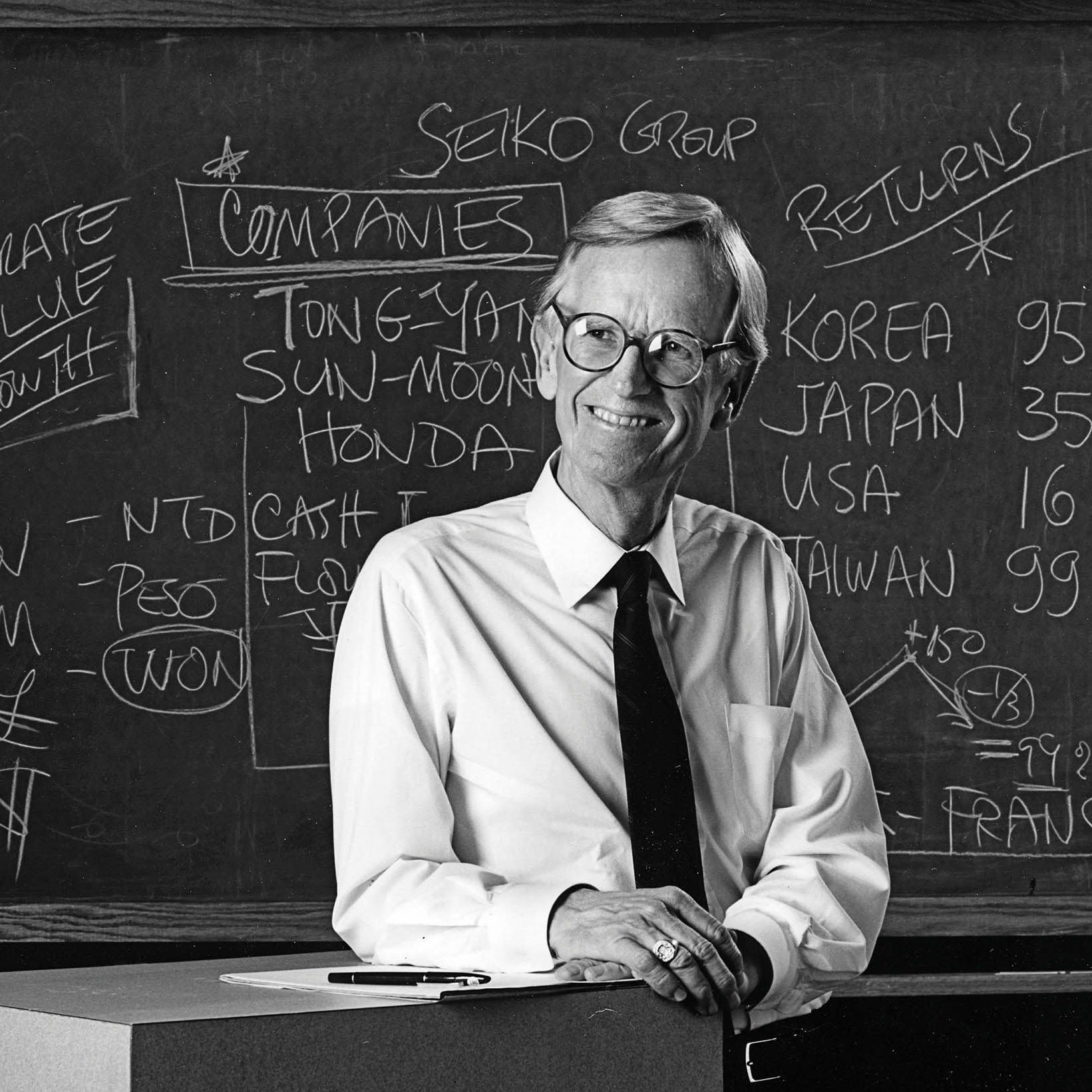
Jack McDonald, MBA ’62, PhD ’67, created a master class on investing that’s still paying dividends nearly 60 years later. Drawing from classic texts and principles, McDonald constructed an emblematic Stanford GSB elective taken by more than 5,000 students (and counting). “The essentials of financial analysis and the basic tools and disciplines that one must learn in becoming a fundamental investor are not really all that new,” he said. McDonald died in 2018, but that mindset remains at the heart of “Jack’s class.”
GSB Archives
See You at The Birds
Since it was installed in 1966, The Flame Birds has been a focal point, meeting place, and Stanford GSB icon. Created by François Stahly, a German-French sculptor, the artwork lived in an unmissable spot in the GSB’s main courtyard until 2011, when it was relocated to the southwest entrance of the new Knight Management Center.
GSB Archives | First illustration by Hello Von

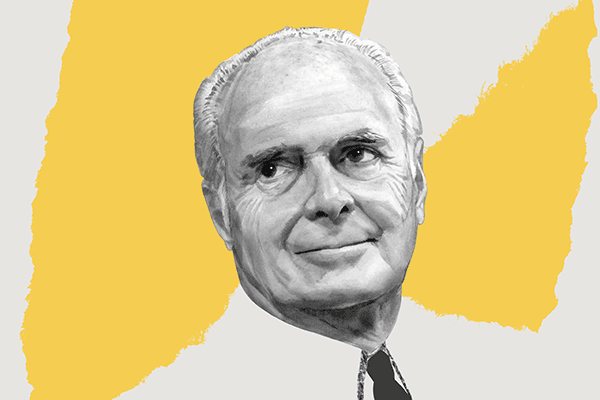
Ron Daniels, CEO of McKinsey & Company, is the inaugural guest in the dean’s premier speaker series.
8.8k
MBA degrees to date
590
MS degrees to date
2.7k
SEP degrees to date
210
PhD degrees to date
12k
Total degrees to date
Scroll or drag to see all
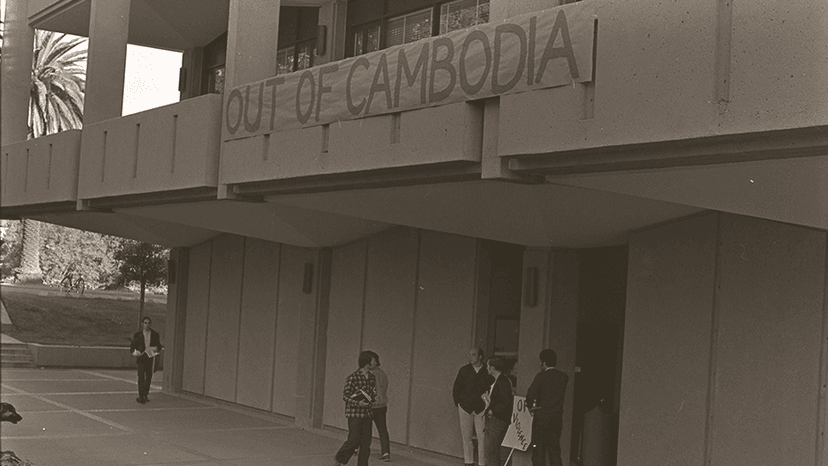
In May, Stanford GSB students vote for a three-day “non-coercive strike” to protest the U.S. invasion of Cambodia.
Dean Miller establishes the Public Management Program to bridge the gap between business and government, the first program of its kind at a U.S. business school.
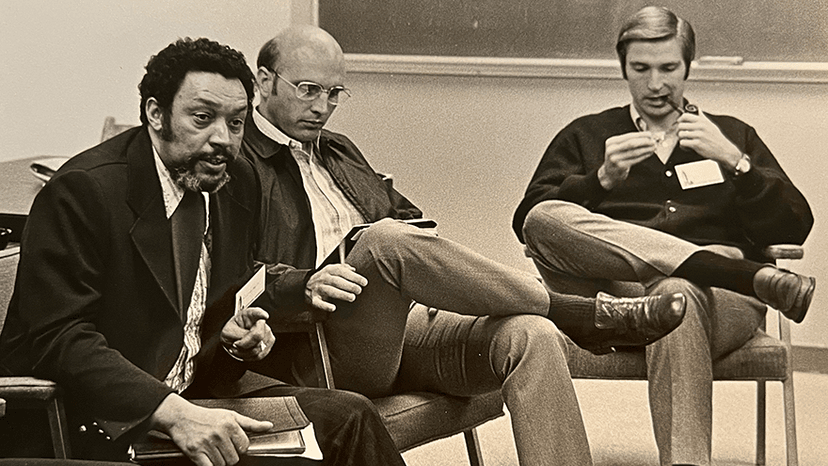
The core curriculum is updated to include more electives and a four-week computer course. Traditional letter grades are replaced by H (distinction), P (pass), and U (unsatisfactory).
The updated 1972 curriculum includes a four-week computer course for incoming MBAs.
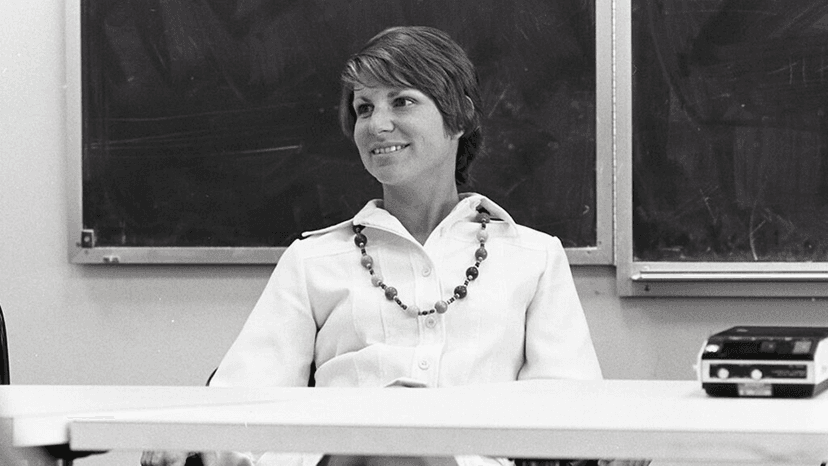
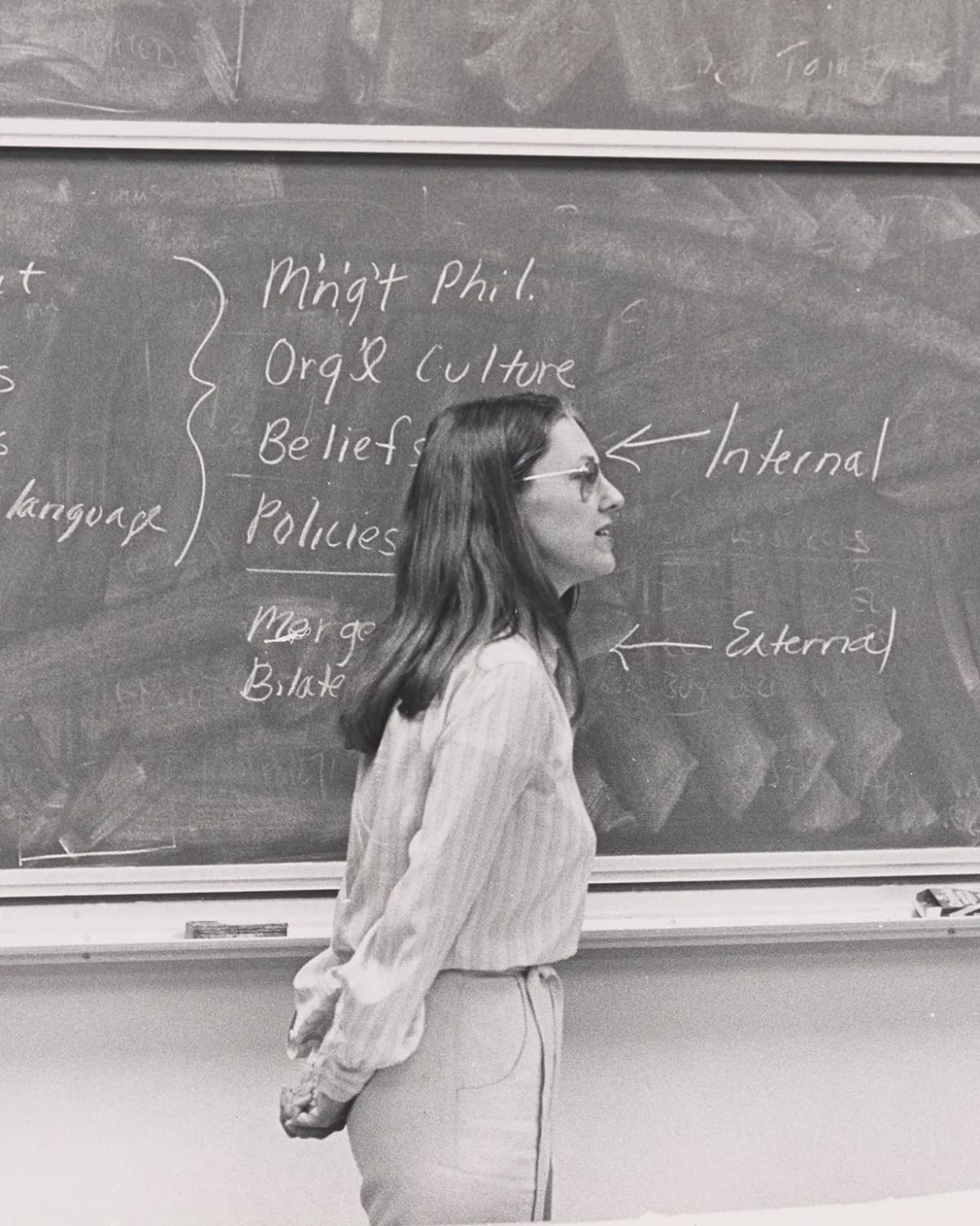
In 1972, Myra Strober, a professor of economics, became one of two women on the faculty.
“As soon as women found they were welcome here, they began to apply in large numbers.”
— Myra Strober, professor emerita of economics
99%
of women with MBAs from Stanford GSB attended since 1970.
In The U.S.
Title IX is passed in 1972. It prohibits sex-based discrimination in any school or educational program that receives federal funding.
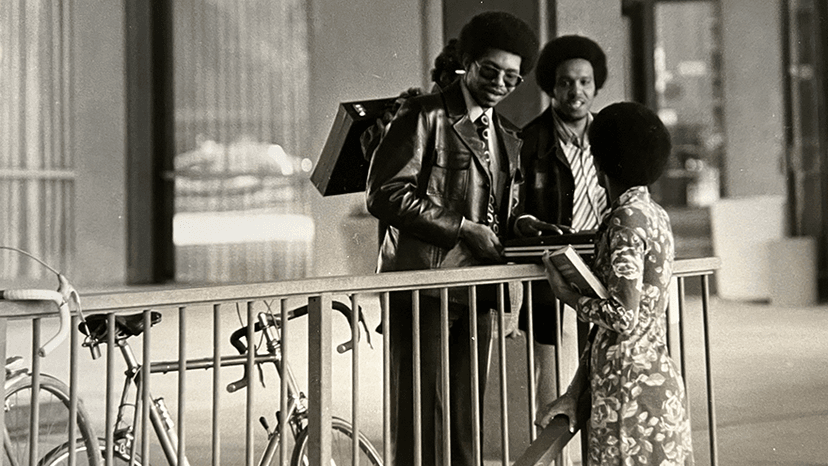
By its 50th anniversary, the School has produced 9,397 alumni working for about 4,000 different organizations throughout the United States and 72 other countries.
The View From The Top speaker series launches. Some of the first guests include Henry Ford II and IBM CEO Frank Cary, MBA ’48.
“It is as fashionable to dismiss political liberalism as it is to dismiss capitalism. The tradition of freedom and tolerance — which many have called the liberal tradition — is, perhaps, capitalism’s greatest contribution and achievement.”
— Henry Ford II, Ford Motor Company chairman, at View From The Top, 1979
In 1978, Stanford GSB buys a $750,000 DEC System 20 computer as well as five Apple IIs to run VisiCalc, the first spreadsheet program.
Climate Change
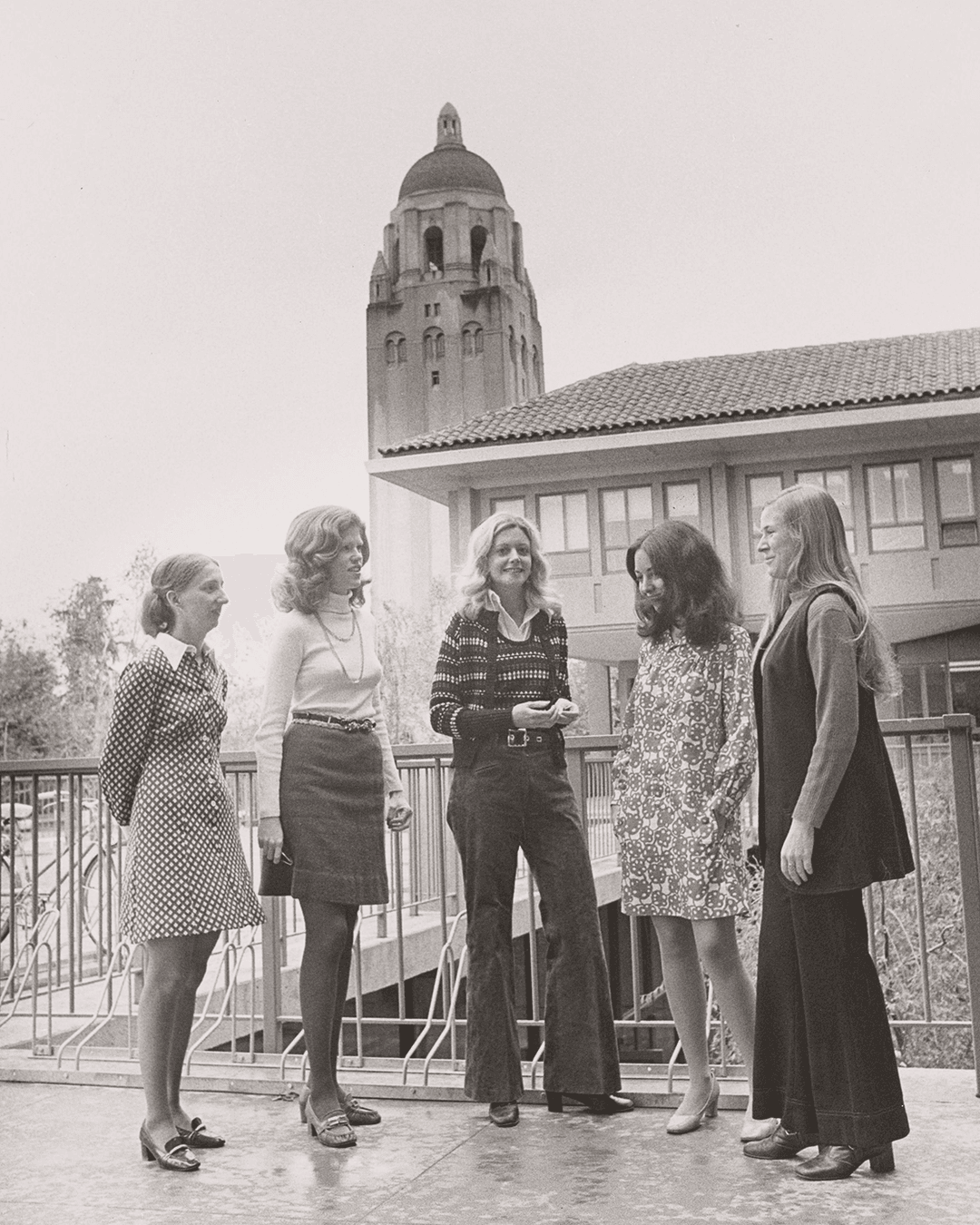
In 1970, five women joined the Stanford GSB’s incoming MBA class, an “inflection point” for the school. Initially facing skepticism and frustration, they persevered, gaining skills and confidence. After graduation, the women of the Class of ’72 built careers and mentored others, helping expand women’s enrollment to nearly half of MBA students. “The real impact of having women in the school was not so much a feminizing effect but a humanizing one,” a classmate recalled.
GSB Archives
Service Industry
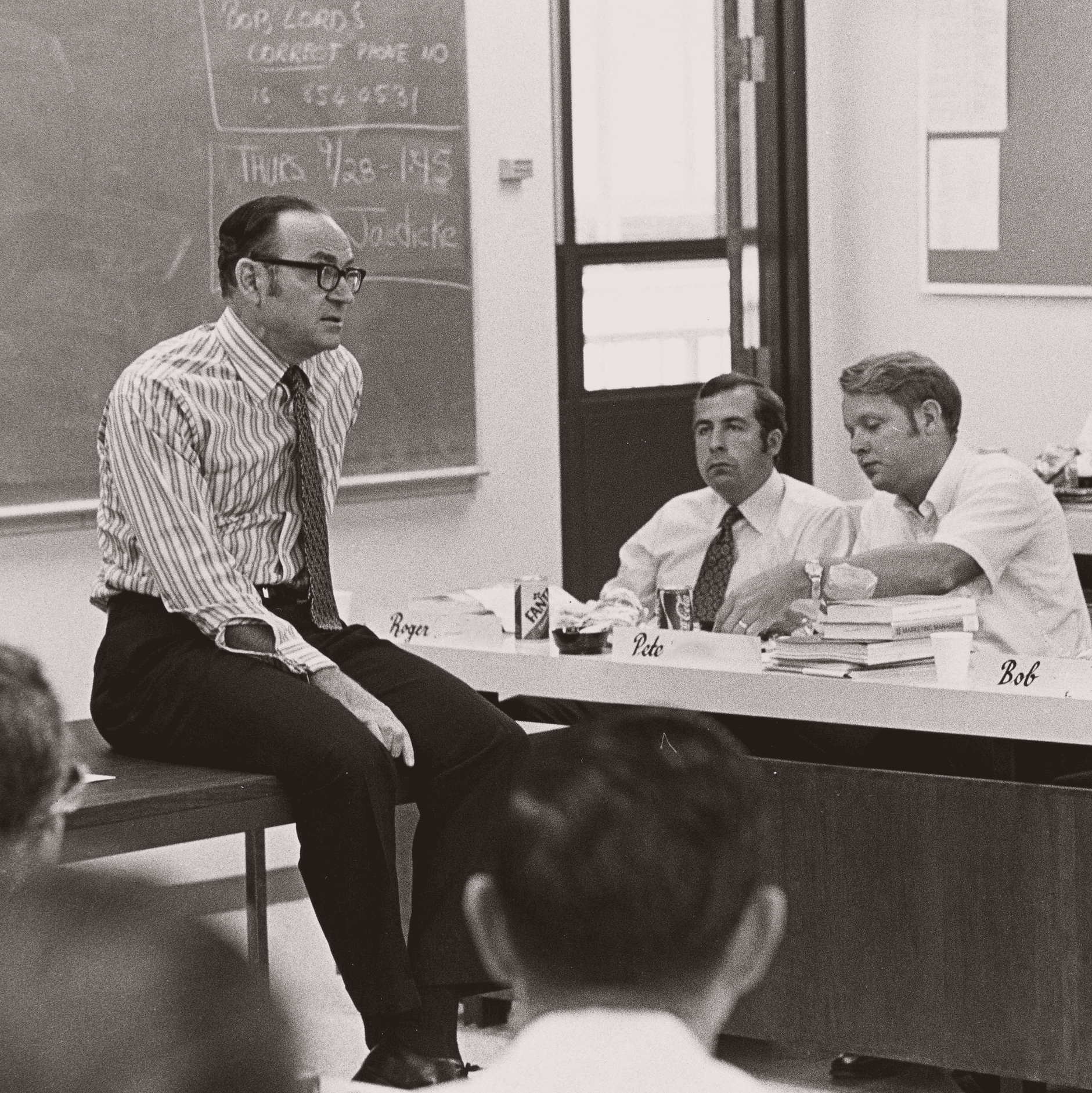
When Stanford GSB offered Arjay Miller the deanship, he agreed to take the job if the school promised to start a program to train managers for the public sector. Miller became dean in 1969, and in 1971, the Public Management Program (PMP) was born. In its early days, the program had a simple mandate: 40 spaces were reserved for applicants who wanted to go into public service. While its core mission remained intact, the PMP evolved over the next 25 years and has become the Center for Social Innovation.
GSB Archives
GSB Archives | First illustration by Hello Von
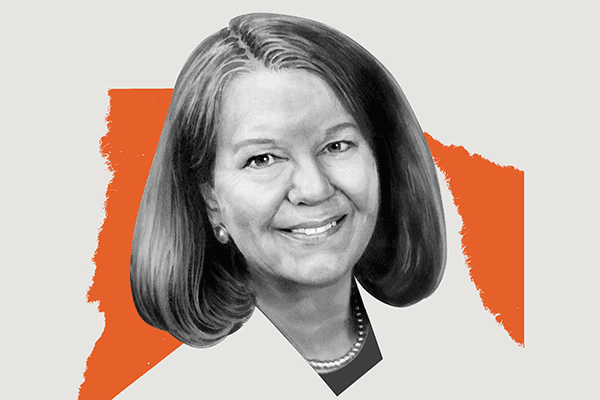
Joanne Martin, the Fred H. Merrill Professor of Organizational Behavior, Emerita, becomes the first woman to receive tenure at the GSB.
12k
MBA degrees to date
1k
MS degrees to date
4.6k
SEP degrees to date
354
PhD degrees to date
18k
Total degrees to date
Scroll or drag to see all
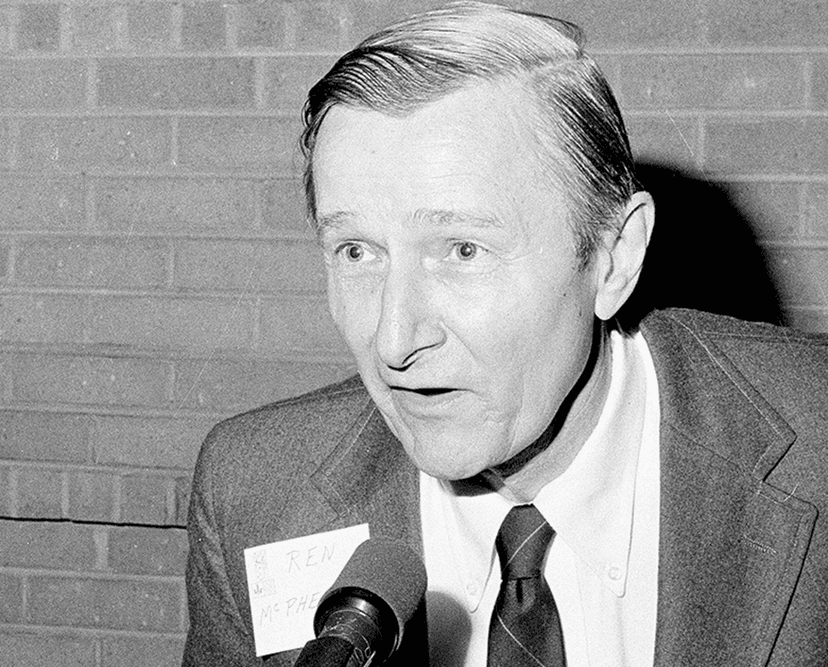
Rene McPherson, the former chairman and CEO of Dana Corp., becomes dean.
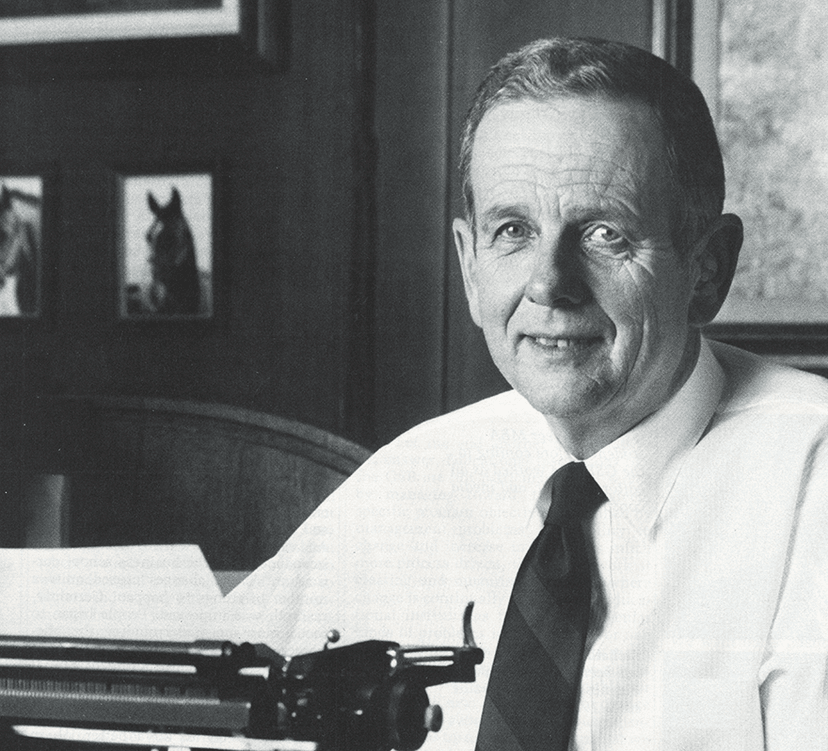
Robert Jaedicke, a professor of accounting at Stanford GSB, becomes dean.
70%
Percentage of incoming MBA students in 1982 who said they’d had experience with computers
150
Total number of terminals on campus in 1981
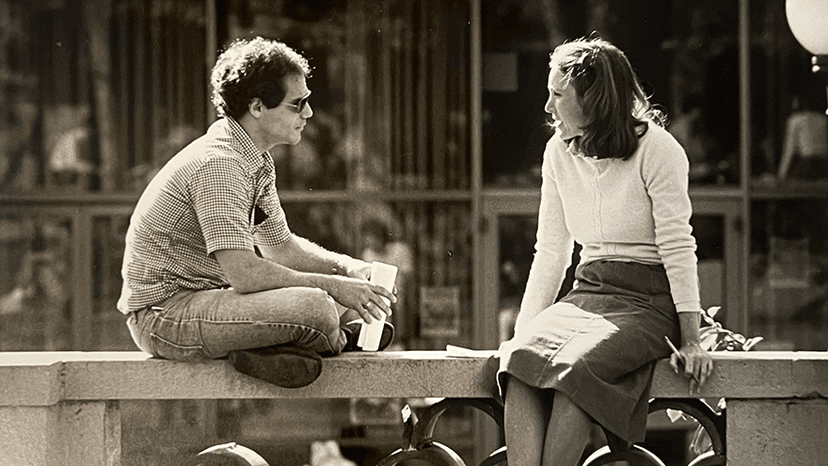
In 1983, the school rolls out a “free market” course signup system in which MBA students compete to enroll in popular classes. Each student receives 100 points and can bid up to 97 on a particular class. “Winners are often seen jumping for joy in the halls,” the Stanford GSB magazine reports.
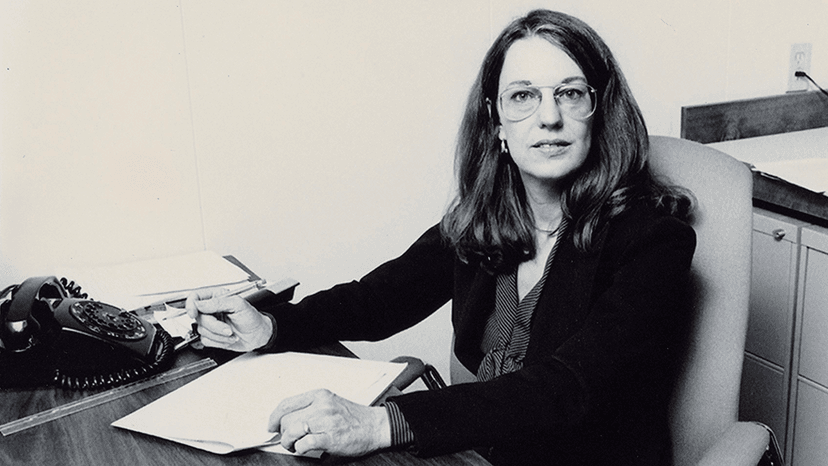
First tenured female faculty Joanne Martin, the Fred H. Merrill Professor of Organizational Behavior, Emerita.
Fifty MBA students travel to Japan on the first Global Study Trip.
MBA alumnae Debbie Pine and Alison Elliott create the Alumni Consulting Team (ACT) to provide pro bono consulting for nonprofits.
A loan forgiveness program is created for MBA graduates working in the nonprofit sector.
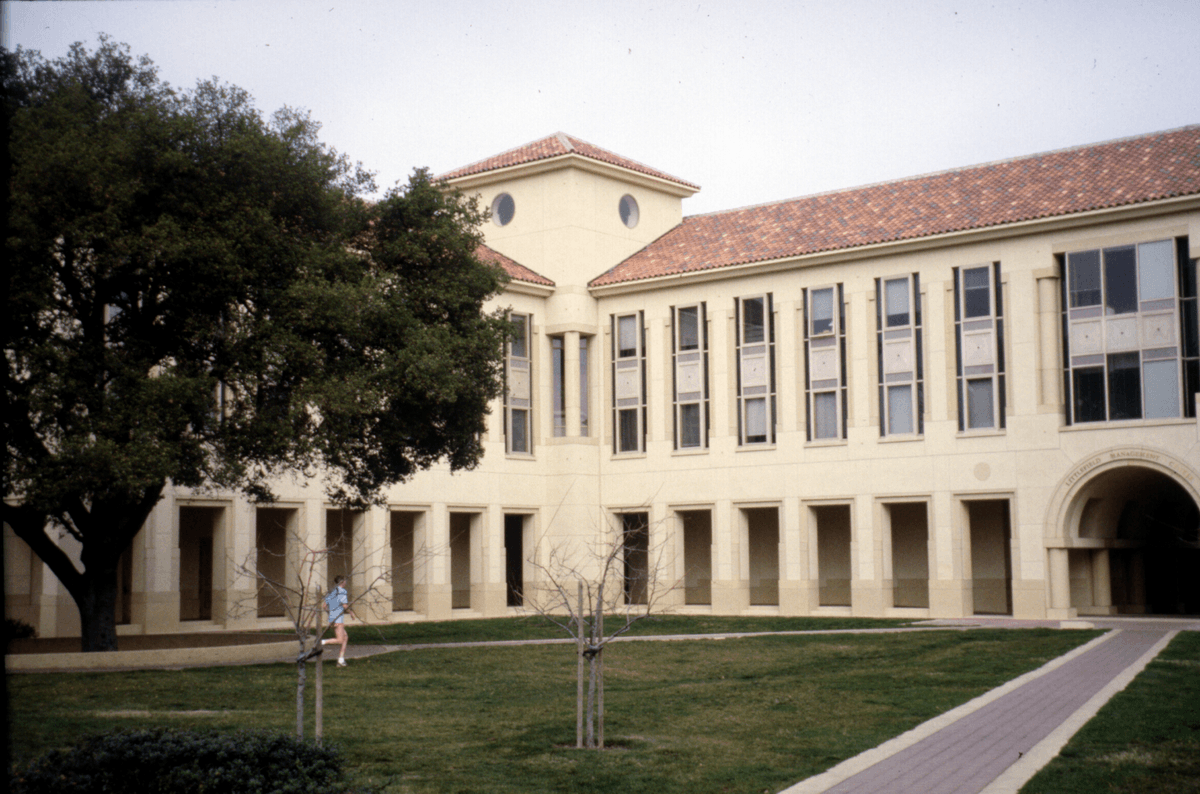
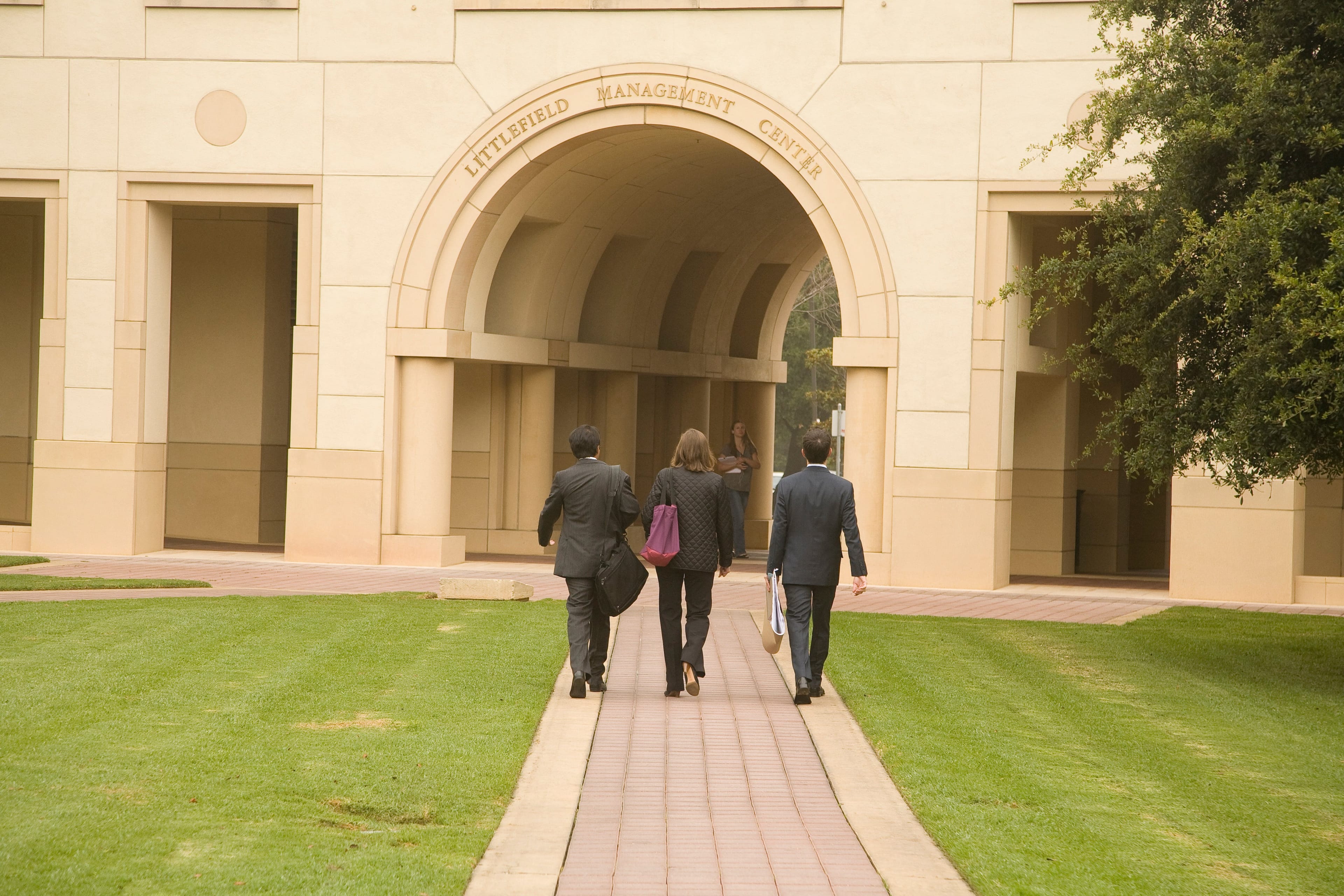
The GSB relocates its faculty offices to a new center named for Edmund W. Littlefield, MBA ’38.
$16.8M
Project cost
60,000
Square feet
102
Faculty offices
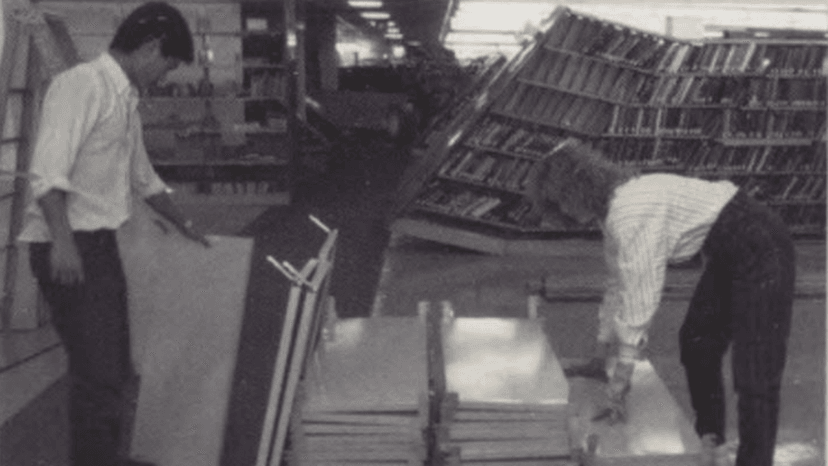
The Loma Prieta earthquake hits the Bay Area. The GSB spends more than $7 million repairing damage and retrofitting buildings.
Movers and Shakers
The weather was almost too perfect on Tuesday, October 17, 1989 — a balmy late afternoon in early autumn. Only a few classes were still in session. In one, students were in the midst of a discussion when the first waves of the Loma Prieta earthquake passed through the building. A woman paused in mid-sentence as her classmates let out a collective, groaning “Wooohhh.”

Big Ideas
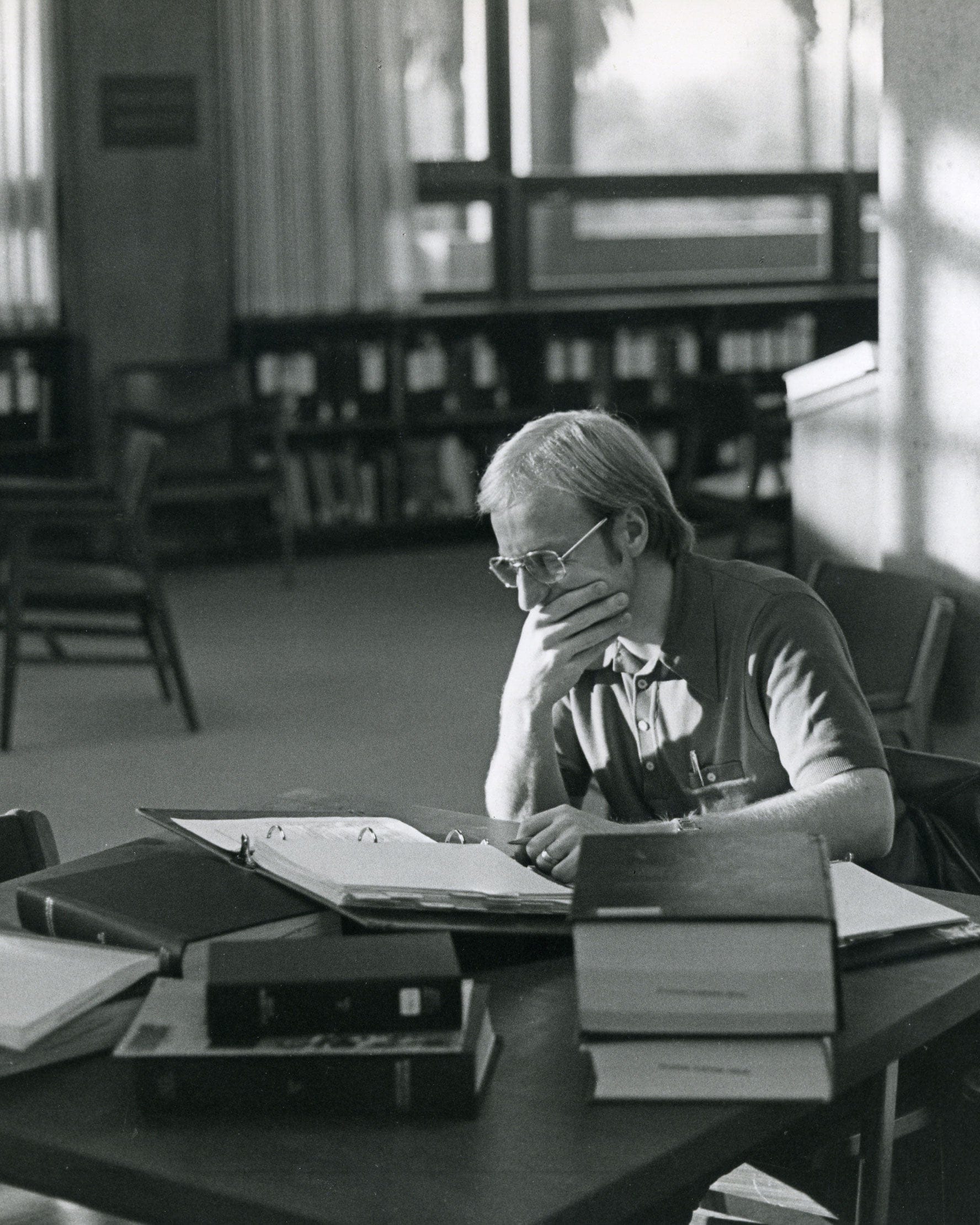
From its earliest days, Stanford Graduate School of Business faculty has had a dual mission: to teach ideas students will take into the world and to create new ideas that will resonate far beyond the classroom. The link between scholarship and impact has always been a crucial part of this equation. Research helps explain the mysteries of how the world works, says professor of organizational behavior Jesper Sørensen — “and if you demystify things, you empower people.”
GSB Archives
GSB Archives | First illustration by Hello Von
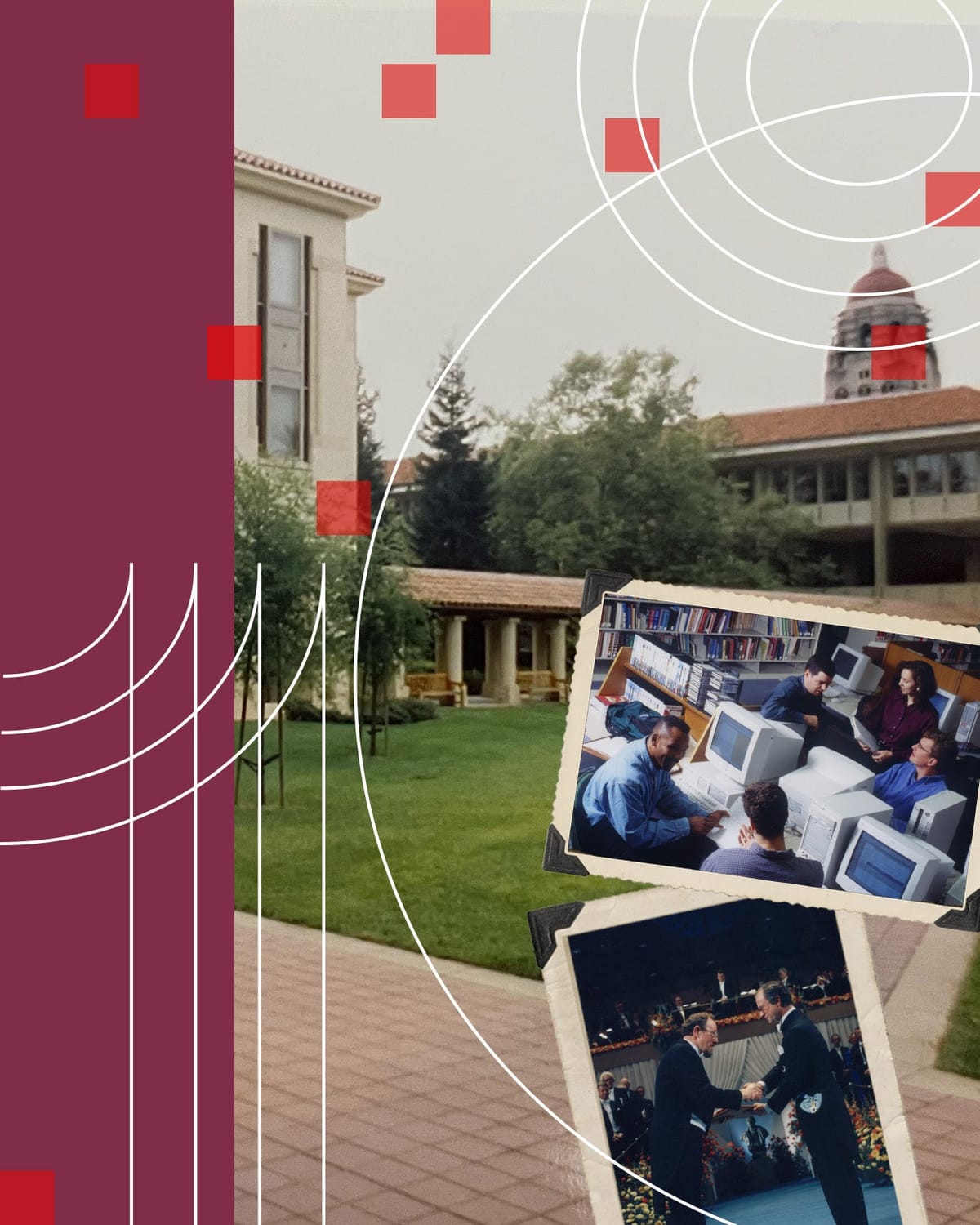

William Sharpe, the STANCO 25 Professor of Finance, Emeritus, receives 1990 Nobel Prize for Economic Sciences for his work in developing models to aid investment decisions.
1.5k
MS degrees to date
15k
MBA degrees to date
6.2k
SEP degrees to date
522
PhD degrees to date
24k
Total degrees to date
Scroll or drag to see all
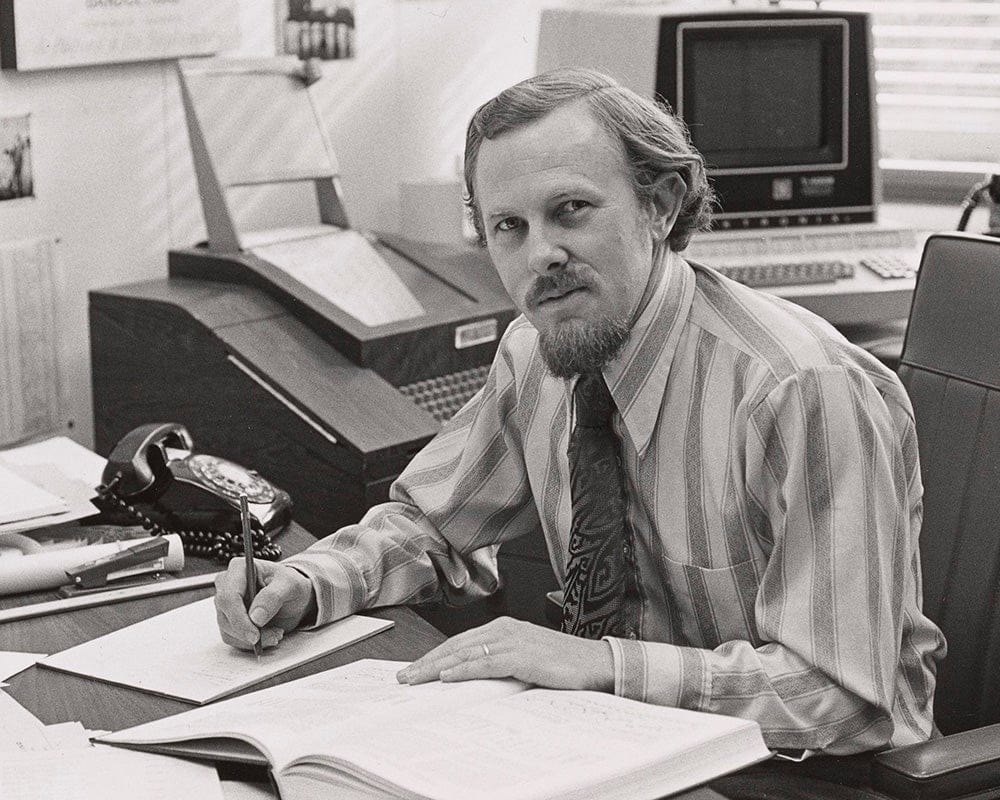
William Sharpe, the STANCO 25 Professor of Finance, Emeritus, receives the Nobel Prize in Economic Sciences, the first of six GSB Nobel recipients.
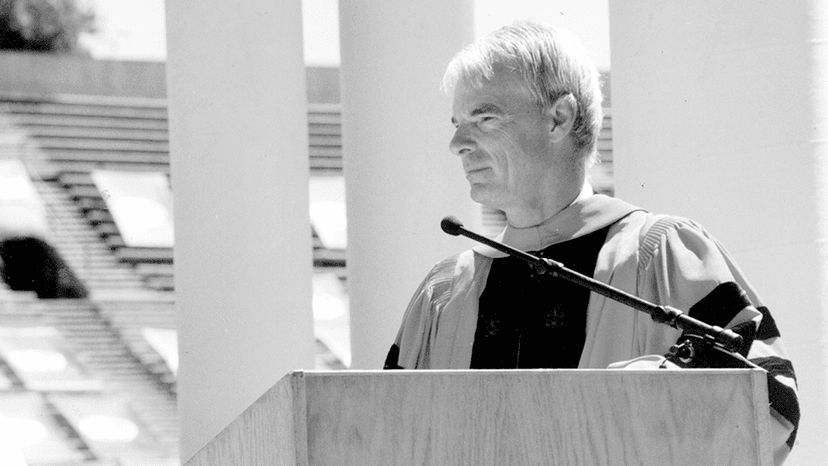
A. Michael Spence, a professor of economics and business administration at Harvard, becomes dean.
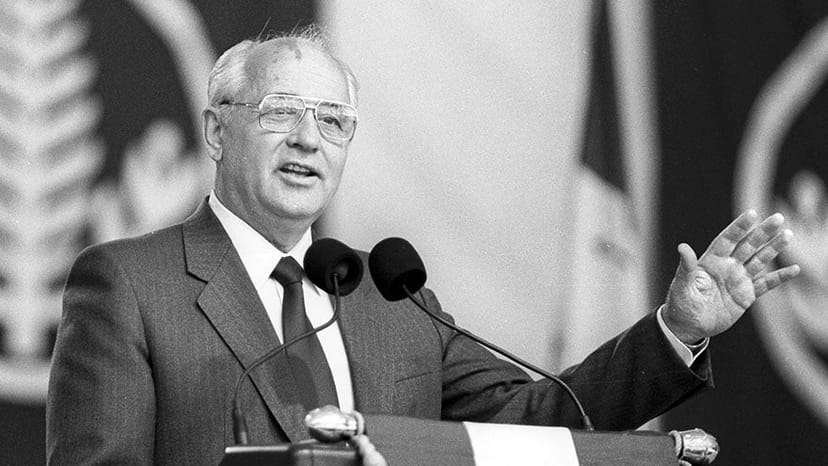
Soviet President Mikhail Gorbachev stopped by the GSB in June 1990 as part of a visit to Stanford facilitated by former Secretary of State George P. Shultz, the Jack Steele Parker Professor of International Economics.

In preparation for Gorby, Stanford GSB got a deep clean, trash cans were removed (for security reasons), and, someone quipped, “even the squirrels were brushed!”
In The World
The Soviet Union dissolves on December 31, 1991
The GSB launches the Center for Entrepreneurial Studies to train entrepreneurial leaders.
“I didn’t want to work for anybody.”
— H. Irvin Grousbeck, the MBA Class of 1980 Adjunct Professor of Management

Myron Scholes, the Frank E. Buck Professor of Finance, Emeritus, receives the Nobel Prize in Economic Sciences.
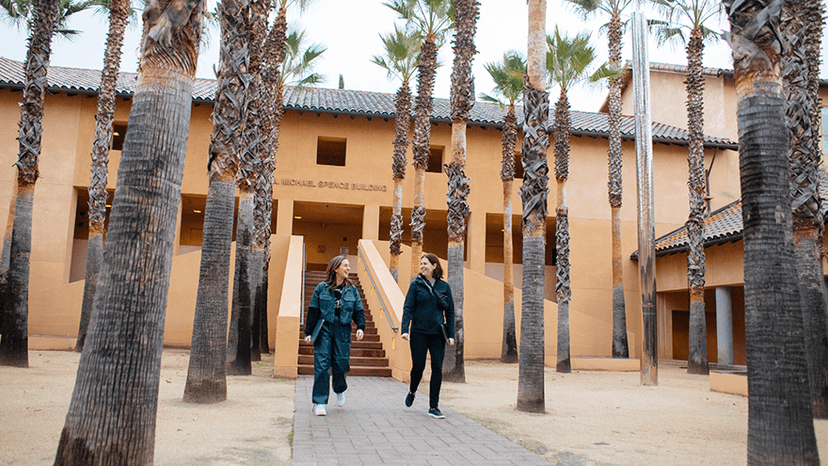
The 280-room Schwab Residential Center, built with lead support from Charles Schwab, MBA ’61, and Helen Schwab, opened its doors in 1997. The new digs were a major upgrade for MBA students — as well as Executive Education participants, who had been staying in undergrad dorms. As the Stanford Daily reported, the execs had been “unenthusiastic about traipsing down the hall” to the shared bathrooms.
Stanford GSB launches the Center for Social Innovation (CSI) to train students to help solve global social and environmental challenges.
The Stanford GSB library is connected to the internet.
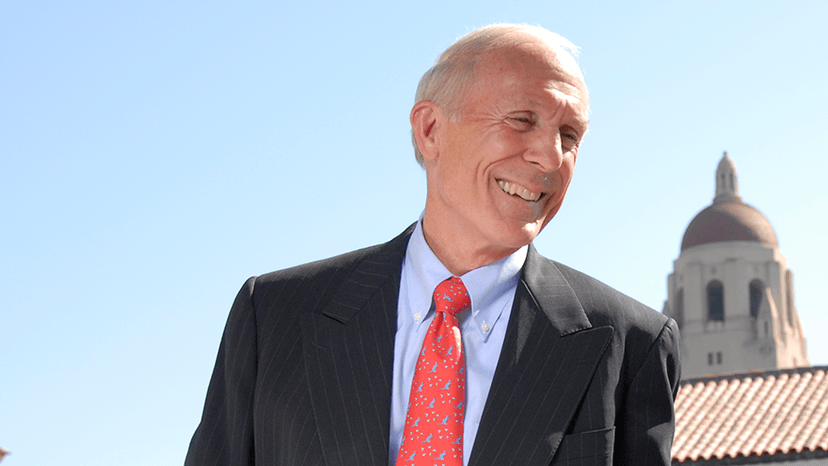
Robert Joss, Sloan ’66, MBA ’67, PhD ’70, the former CEO of Westpac, becomes dean.
Center of Impact
Since 1999, the Center for Social Innovation at Stanford GSB has trained business leaders to leverage markets for social good. “CSI is the conscience of the school,” says Neil Malhotra, the Edith M. Cornell Professor of Political Economy and the center’s faculty director. “Our students learn from world-class faculty and peers about cutting-edge management practices. But our students also explain to others the importance of business as a key institution in society and the need for business to create positive social impact.”
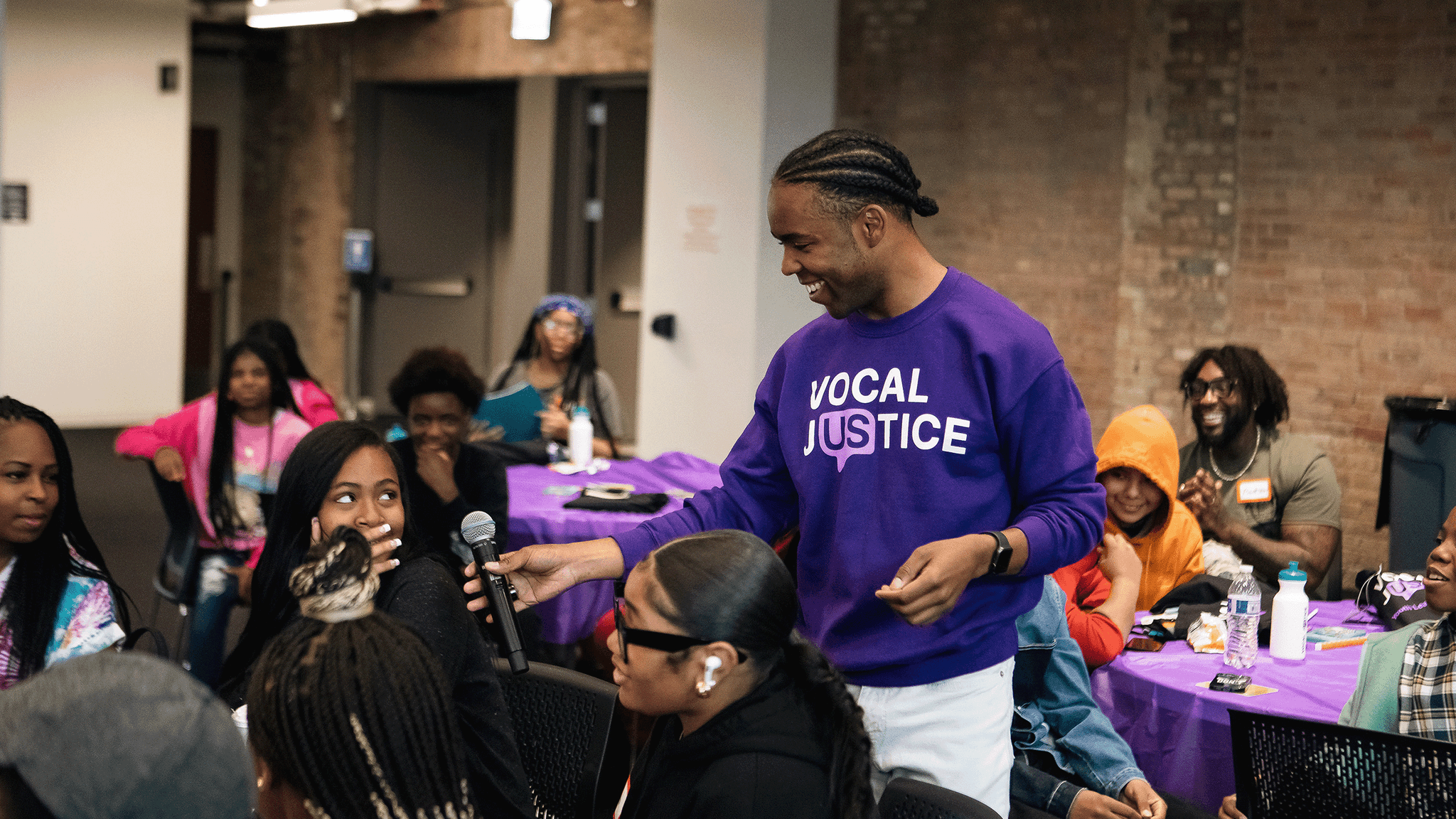
People-Based Insights
The Behavioral Lab (or B-Lab) allows faculty and PhD students to design experiments around human subjects. The lab was created in 1997 when Margaret Neale — now the Adams Distinguished Professor of Management, Emerita — identified a need to study how people interact. “It was clear to me that having this resource would substantially improve the quality of research possible,” Neale says. More than 250,000 participants are part of B-Lab studies every year.
Courtesy of the Research Hub
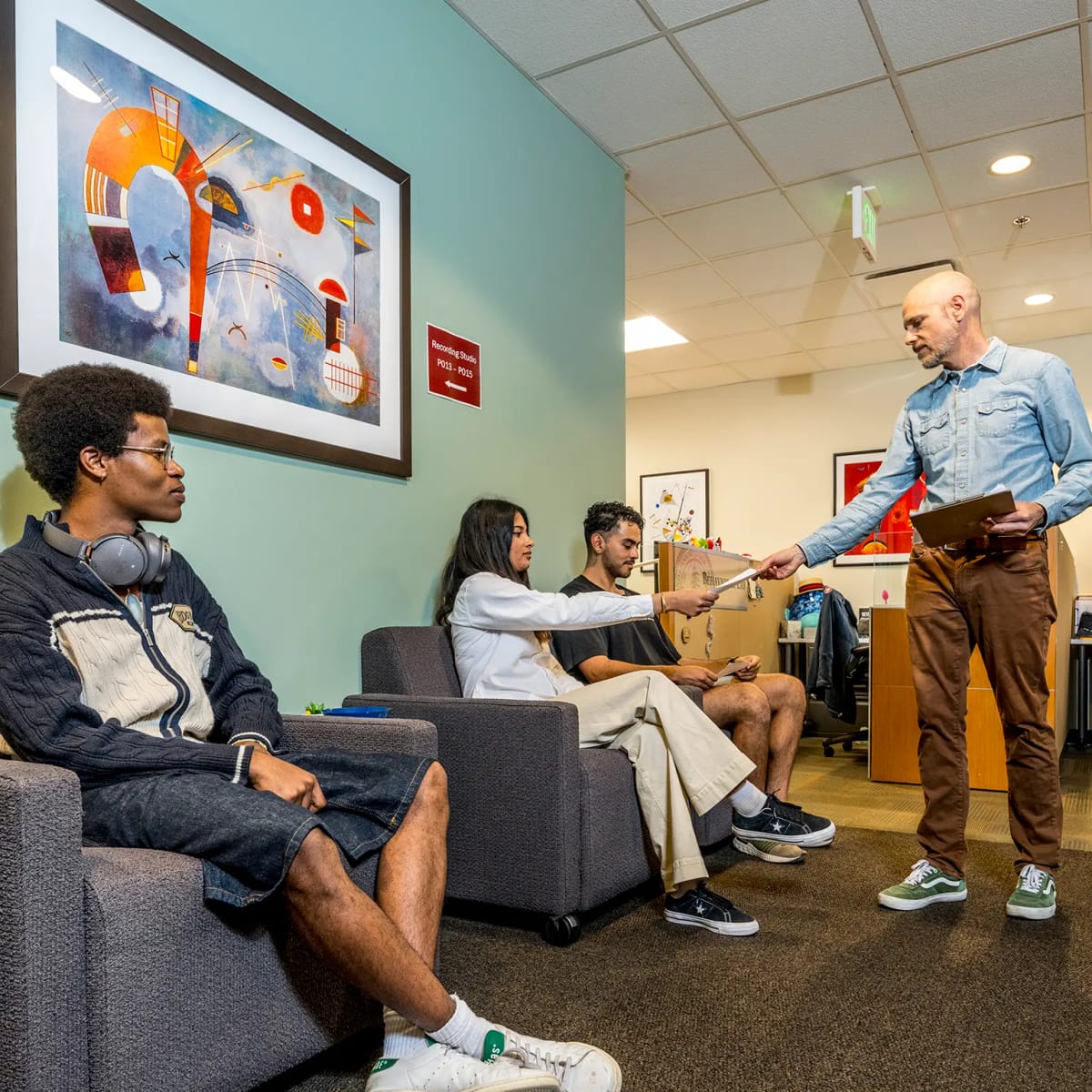
GSB Archives | First illustration by Hello Von
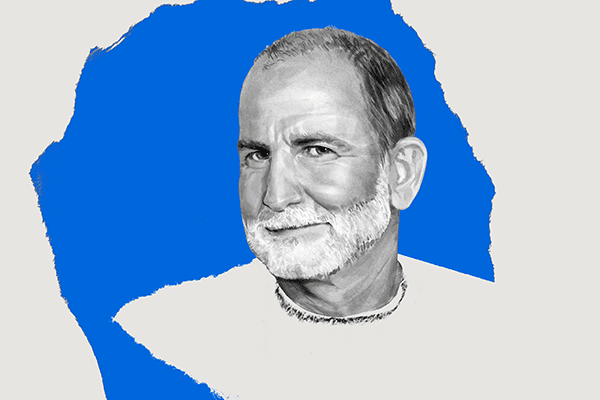
Bill Guttentag, lecturer in Organizational Behavior, wins for the 2003 documentary Twin Towers.
1.5k
MS degrees to date
19k
MBA degrees to date
7.4k
SEP degrees to date
735
PhD degrees to date
29k
Total degrees to date
Scroll or drag to see all

An annual year-end tradition for more than 25 years, the Stanford GSB show is a multi-media event that celebrates and parodies the MBA experience — and is entirely written, directed, and performed by students.
“The GSB Show is the most ridiculous thing you’ve ever seen in your life. It’s a little bit pretentious, it’s a little bit offensive, but it is hilarious.”
— Member of the Class of 2016
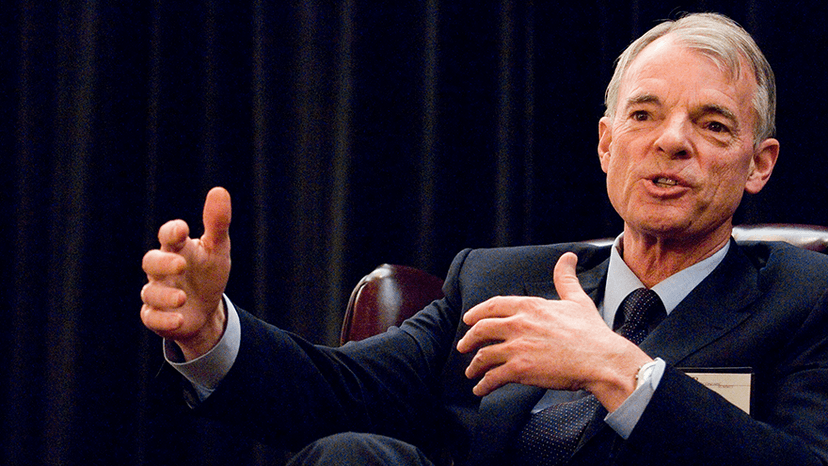
A. Michael Spence, former dean and the Philip H. Knight Professor, Emeritus, receives the Nobel Prize in Economic Sciences.
A new MBA core curriculum is adopted following the recommendations of faculty, students, and alums.
At the end of their first quarter at Stanford GSB, first-year MBA students face alumni and faculty judges in the annual Executive Challenge. Every year since 2007, members of the school community have come together to create an experience that can’t be found anywhere else: Six-person squads, each guided by a second-year Arbuckle Leadership Fellow, pair off to role-play three business cases with three panels of judges.
Until the day of the challenge, the students don’t know the details of those scenarios — situations that will allow them to spread their wings and to experience what being a real-world executive actually feels like.

Garth Saloner, the Botha-Chan Professor of Economics, becomes dean.
Bragging Rights
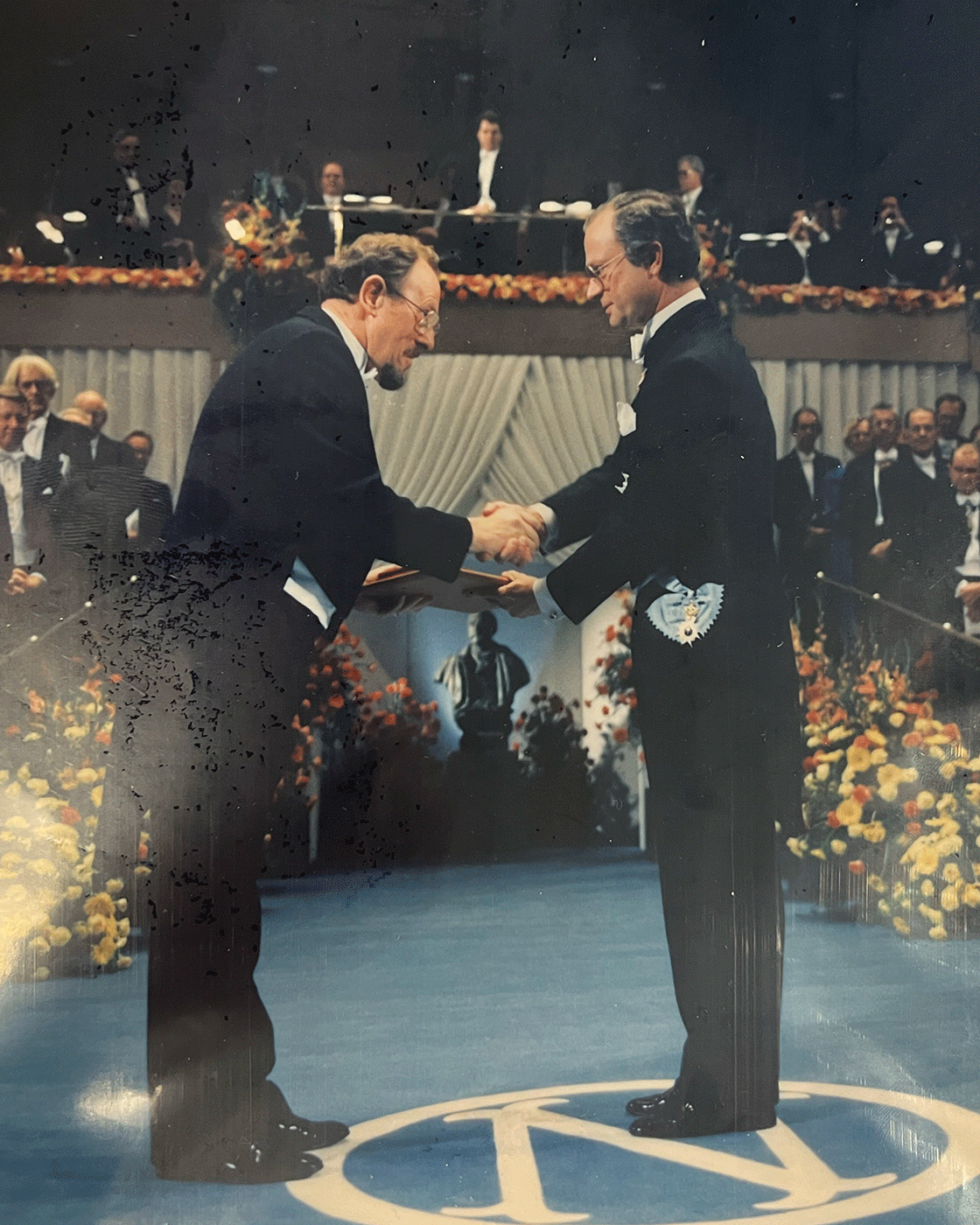
Over the past century, six Stanford GSB professors have been awarded the Nobel Prize. Established in 1968, the Sveriges Riksbank Prize in Economic Sciences in Memory of Alfred Nobel is awarded for scholarship that has proved foundational within the discipline. The award comes with 11 million Swedish kronor (about $1 million), as well as a gold medal, a diploma, and a lifetime of bragging rights. Learn the why and how each professor won.
GSB Archives
Oral History
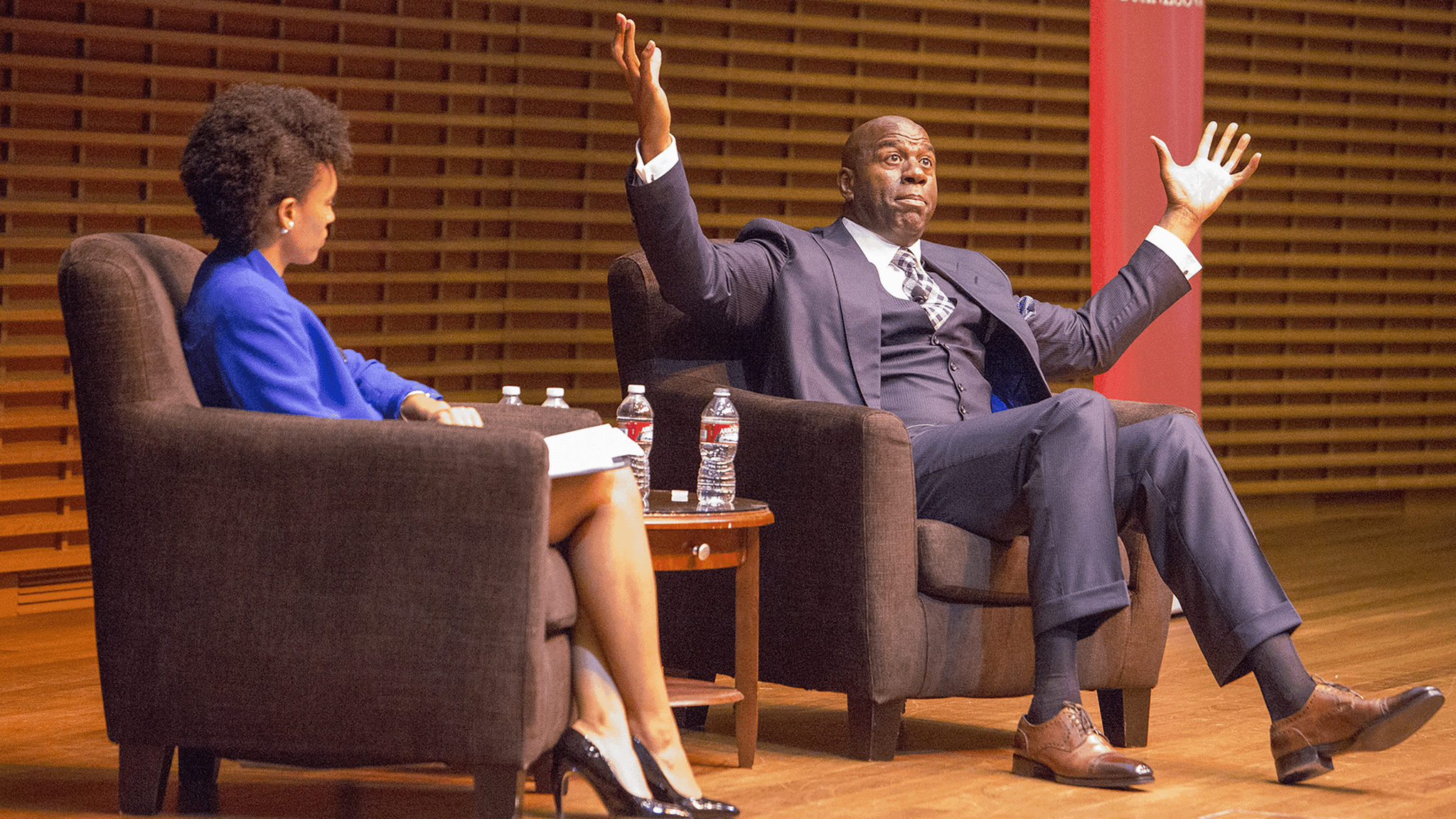
On any given day at Stanford GSB, you might catch a founder dropping into a class, a policymaker keynoting a conference, or a CEO speaking just feet away in CEMEX Auditorium. Here’s a sampling of memorable quotes and quips from a few of the hundreds of guests who have spoken at the school over the years, from Steve Jobs to Oprah Winfrey.
GSB Archives | First illustration by Hello Von
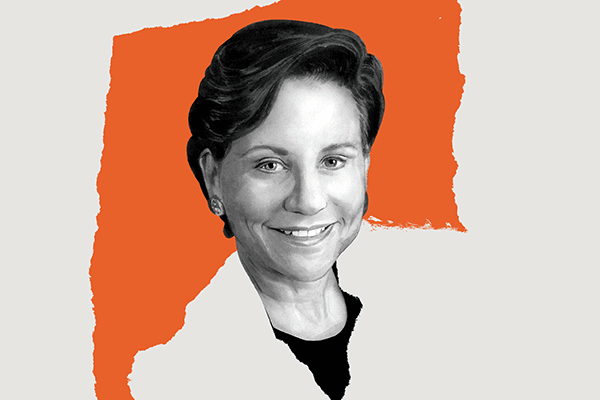
Penny Pritzker, JD/MBA ’84, serves as U.S. Secretary of Commerce from 2013–2017.
23k
MBA degrees to date
2.8k
MS degrees to date
9k
SEP degrees to date
951
PhD degrees to date
36k
Total degrees to date
Scroll or drag to see all
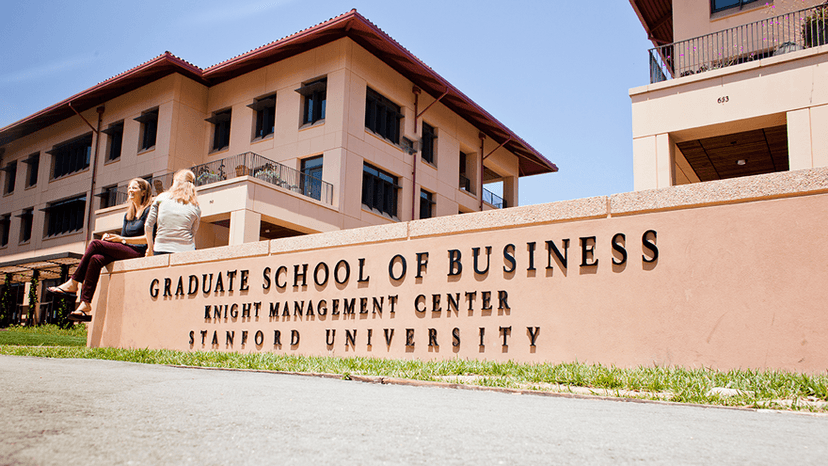
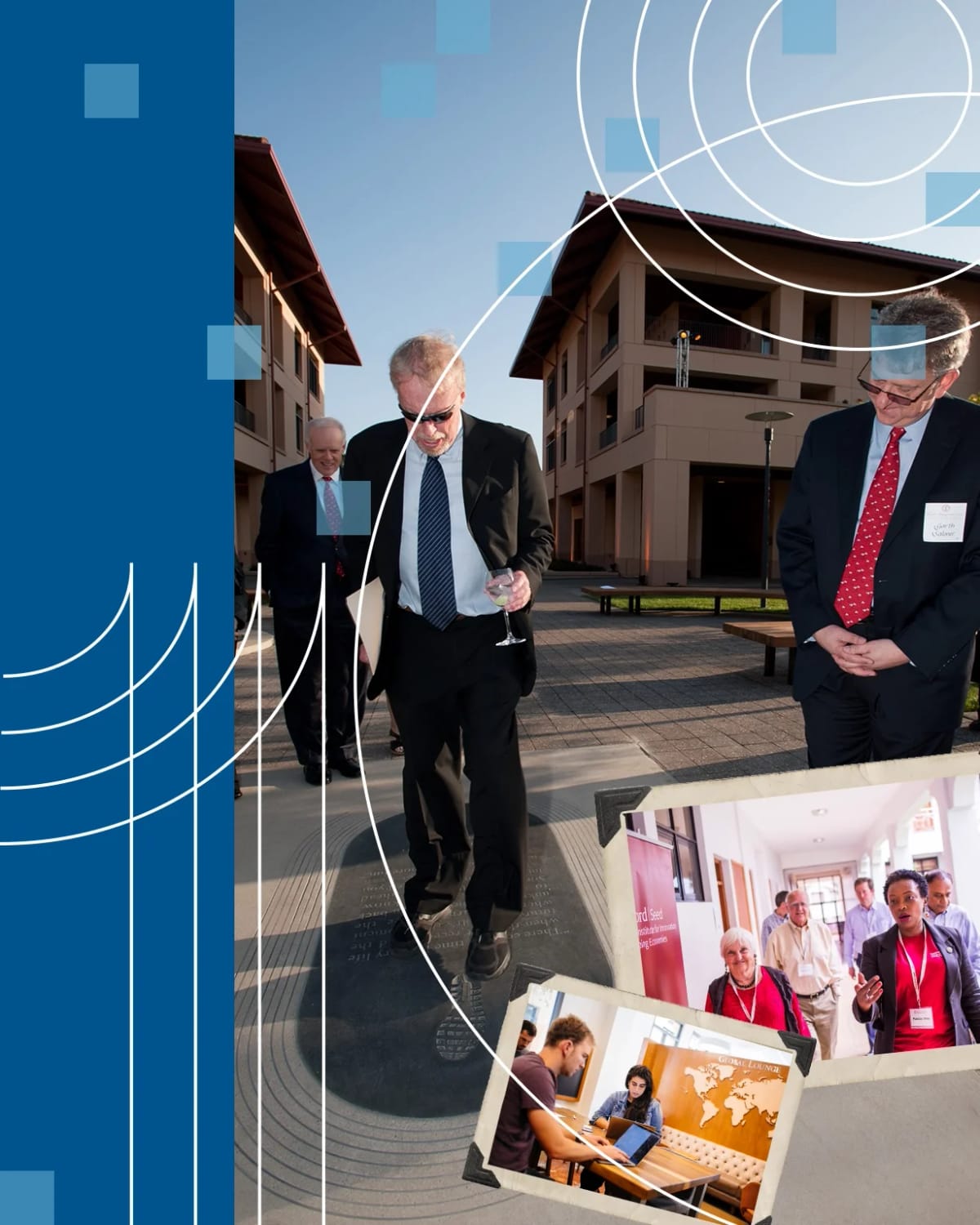
The business school relocates to the Knight Management Center, a new campus constructed with funds donated by Nike founder and chairman Philip Knight, MBA ’62.
360,000
Square feet
12.5
Acres
8
Buildings
$345M
Project cost
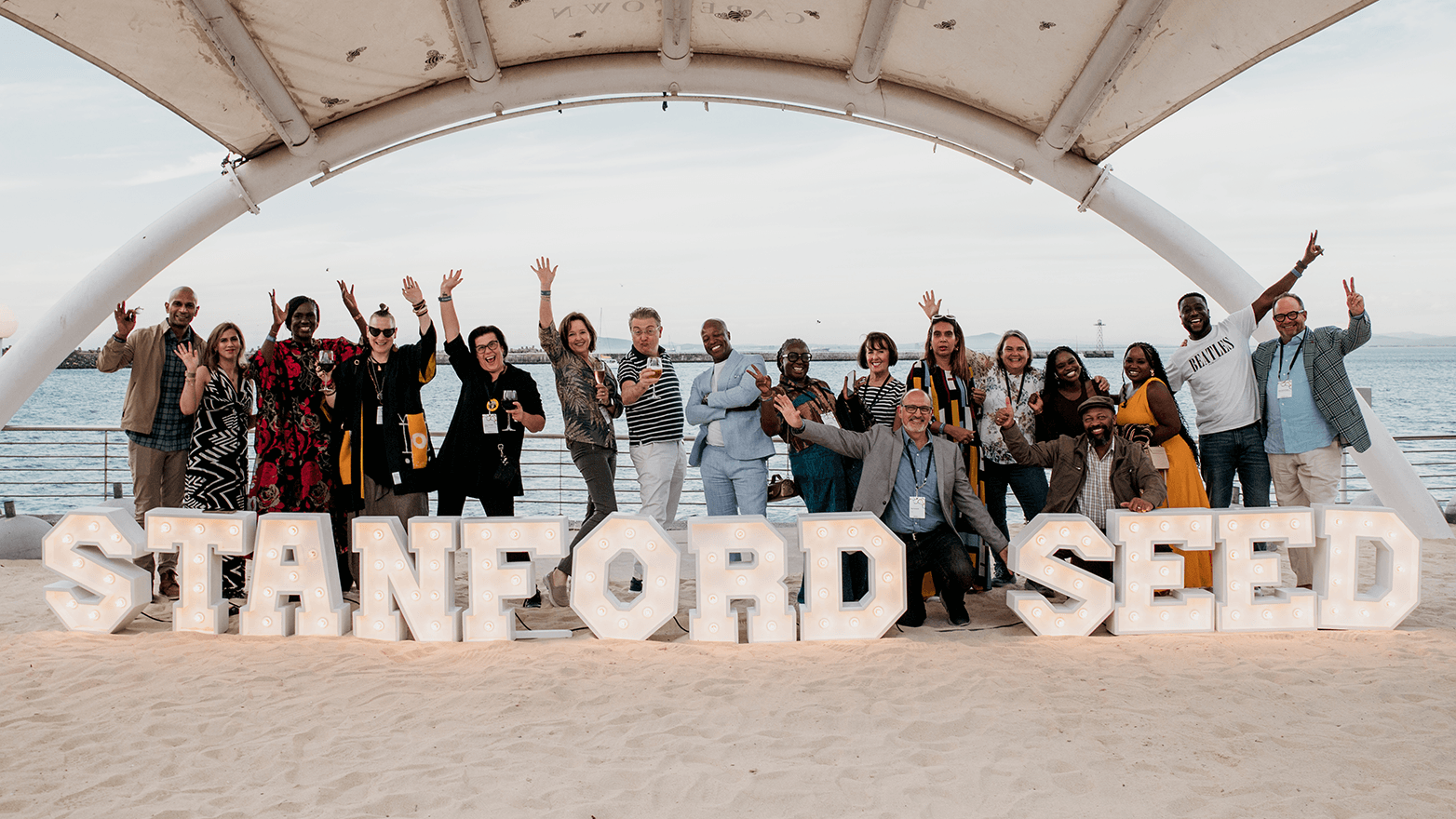
The Stanford Institute for Innovation in Developing Economies (Stanford Seed) is launched to partner with entrepreneurs from Africa, Indonesia, and South Asia.
The redesigned Stanford Sloan Master’s Program changes its name to Stanford Master of Science in Management for Experienced Leaders (Stanford MSx).
The Research Fellows Program was started in 2013. In the two-year program, prospective PhD students acquire skills and experience by assisting Stanford GSB faculty with research and taking graduate-level coursework.
“This is a true mentorship program — as one of our faculty has said, the fellow should be getting more out of it than the faculty.”
— Emily Teitelbaum, associate director of the Research Fellows Program
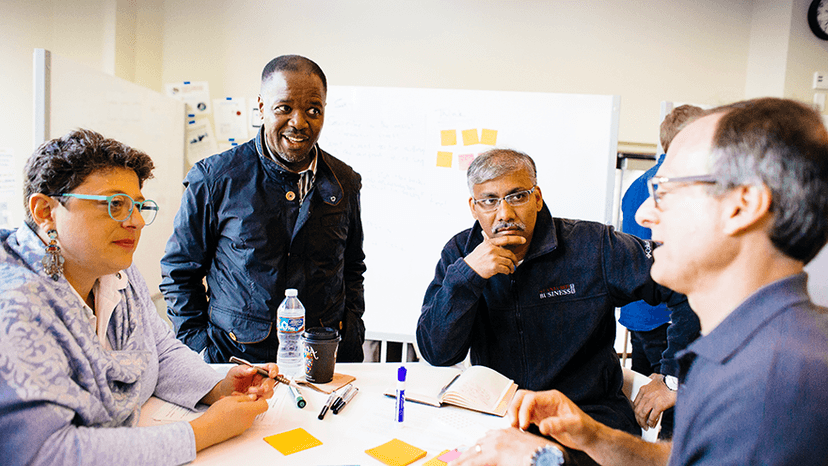
The GSB launches Stanford LEAD, a one-year online business program for mid- to senior-level professionals.

The rigorous, inquiry-based course Startup Garage, known across the Stanford campus for eclectic and unique use of design thinking, lean startup methodologies, flipped classroom approach, and real-world application, is offered for the first time.
Launched in 2015, the Stanford GSB Impact Fund is managed by student leaders under the guidance of faculty, alumni, and expert practitioners. Students gain experience in “impact investing” in companies for financial and measurable social and environmental returns.
All returns are reinvested into new enterprises that strive to make the world a better place.
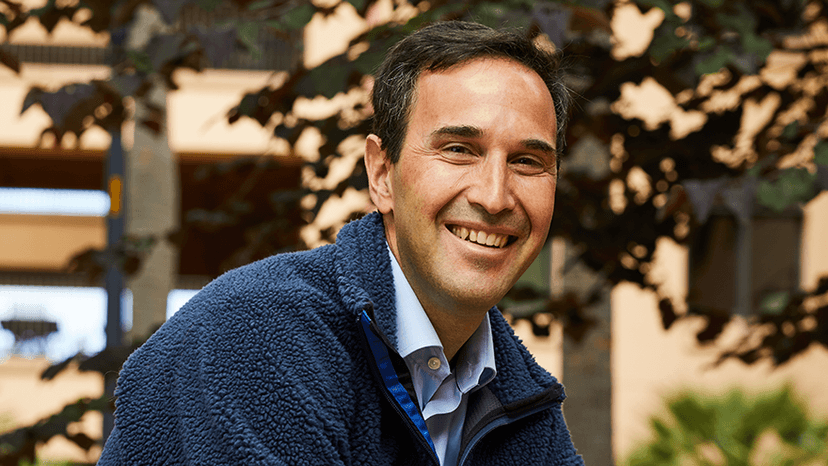
Jonathan Levin, a professor of economics at the GSB and the former chair of the Stanford Department of Economics, becomes dean.
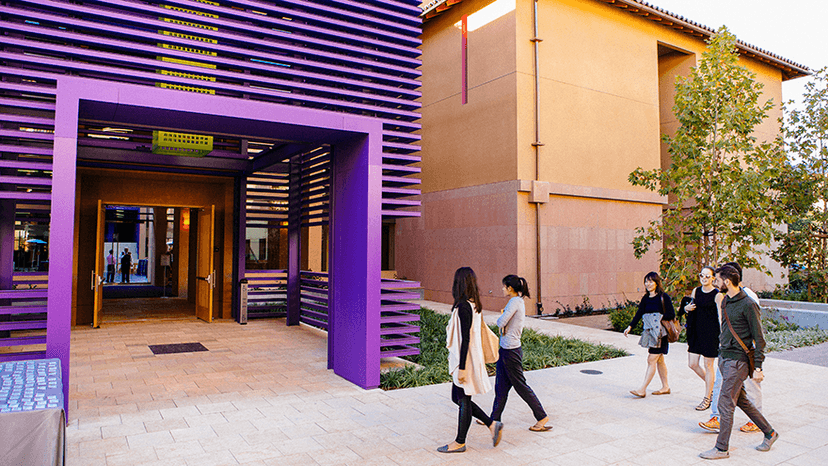
Highland Hall, a new four-story residential housing structure, opens. In 2018, it is renamed after Professor John G. “Jack” McDonald.

The Data, Analytics, and Research Computing (DARC) team is established to assist faculty with data analysis and machine learning as well as run dedicated research servers.
A new AI-focused Executive Education course is introduced. “AI is quickly becoming a critical tool in every industry,” says program director and economics professor Paul Oyer.
LEADing the Way
A decade after its launch as an unprecedented experiment, Stanford LEAD remains Stanford GSB’s flagship online executive education program. “We wanted to open this program to people who may have dreamed of coming to Stanford but never saw that as feasible,” says Peter DeMarzo, the John G. McDonald Professor of Finance and the founder and faculty director of the LEAD program.
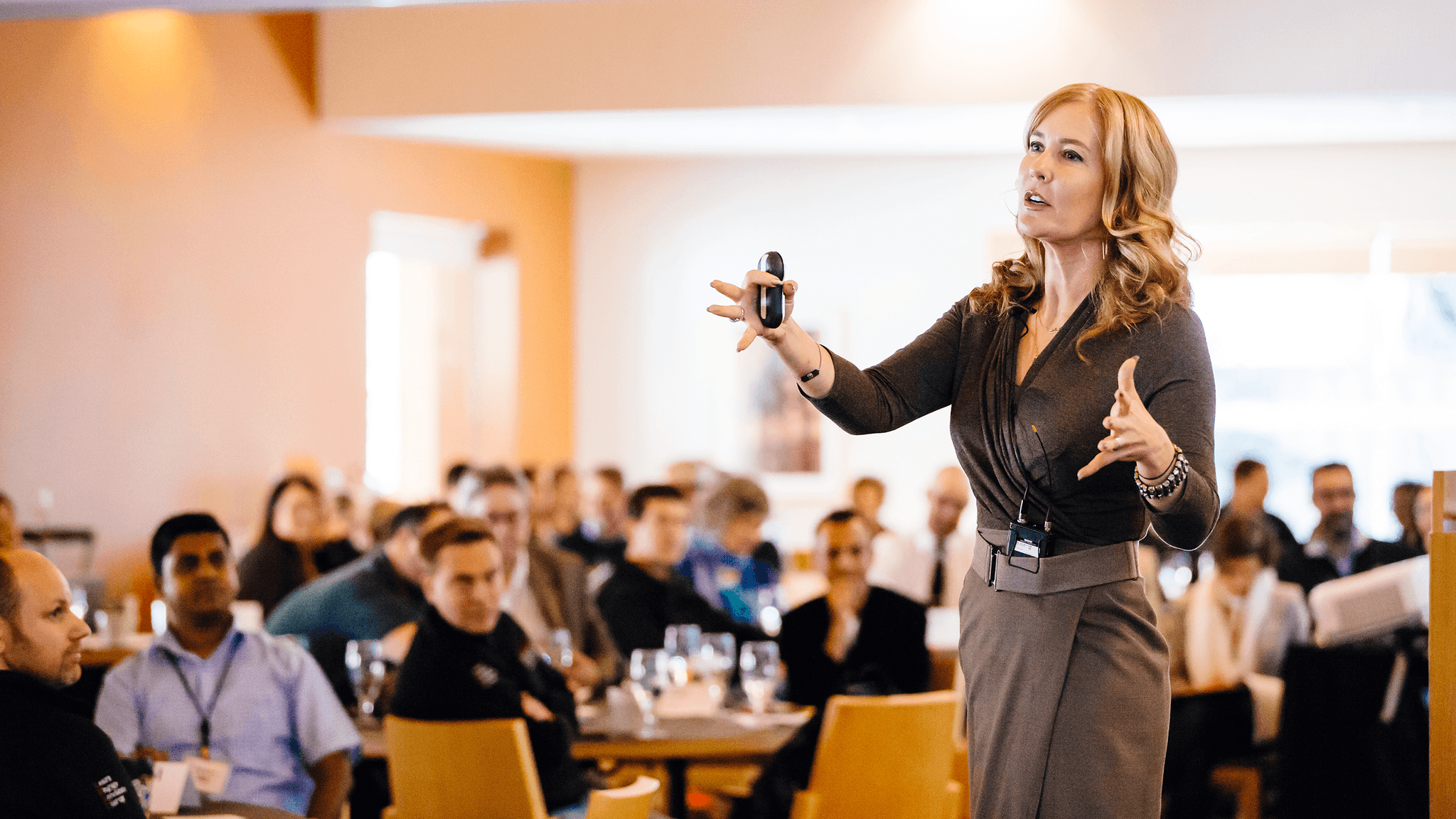
Sowing Impact
The Seed Transformation Program (STP) at Stanford GSB enlists alumni, faculty, students, and staff to help leaders of companies in emerging markets expand their businesses. The goal is to create jobs and lift people out of poverty. “Taking a company from 50 or 100 employees up to 1,000 employees requires a very specific skill set,” says Stanford GSB professor Jesper Sørensen, who serves as Seed’s faculty director. “We focus on helping leaders work through the challenges of doing that.”
Courtesy of SEED

GSB Archives | First illustration by Hello Von
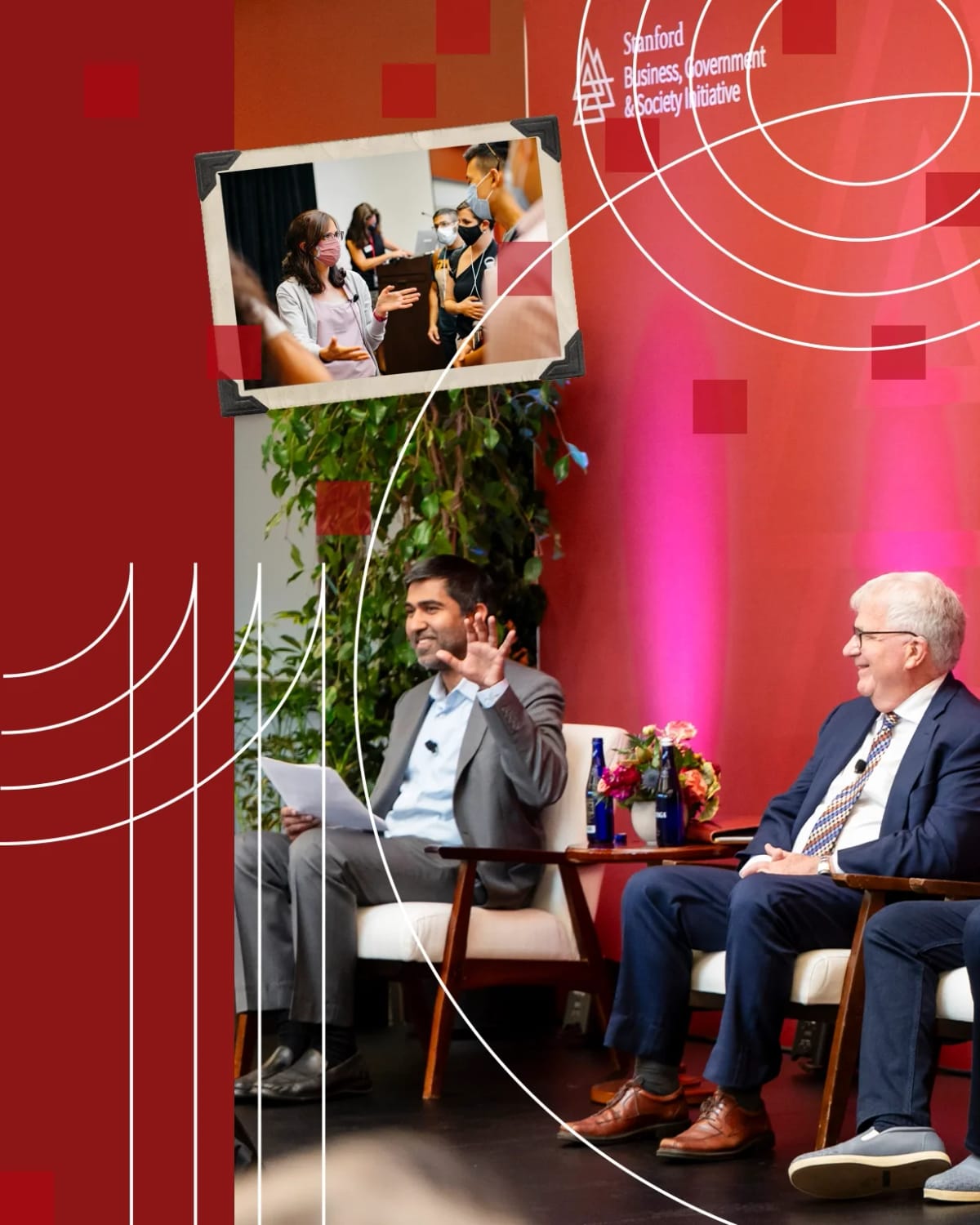

Akshata Murty, MBA ’06, investor and philanthropist, and Rishi Sunak, MBA ’06, prime minister of the United Kingdom from 2022–24.
26k
MBA degrees to date
3.3k
MS degrees to date
10k
SEP degrees to date
1k
PhD degrees to date
40k
Total degrees to date
Scroll or drag to see all
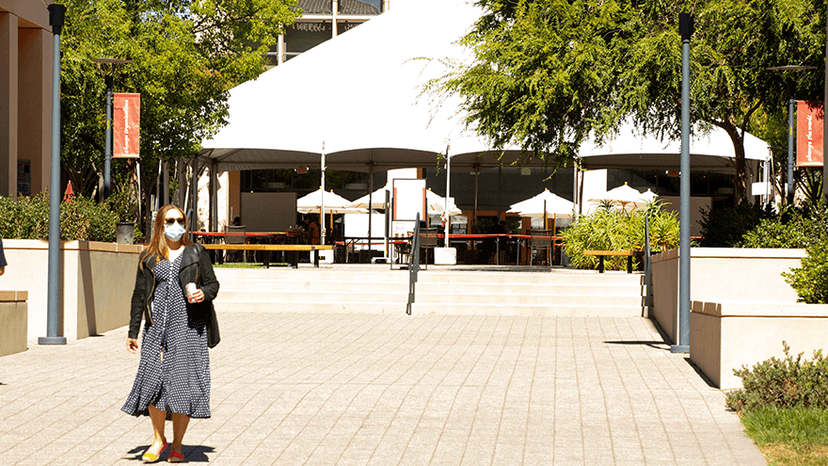
As the COVID pandemic spreads and the Stanford campus shuts down.
“It was like a war room in there: crisis after crisis, patch one up and move on to the next.”
— Paul Oyer, professor of economics
60
Hours to move online
90
Courses
124
Sections
In The World
On March 11, 2020, COVID-19 was declared a pandemic.

Paul Milgrom, PhD ’77, professor of economics (by courtesy), and Robert Wilson, the Adams Distinguished Professor of Management, Emeritus, receive the Nobel Prize in Economic Sciences.
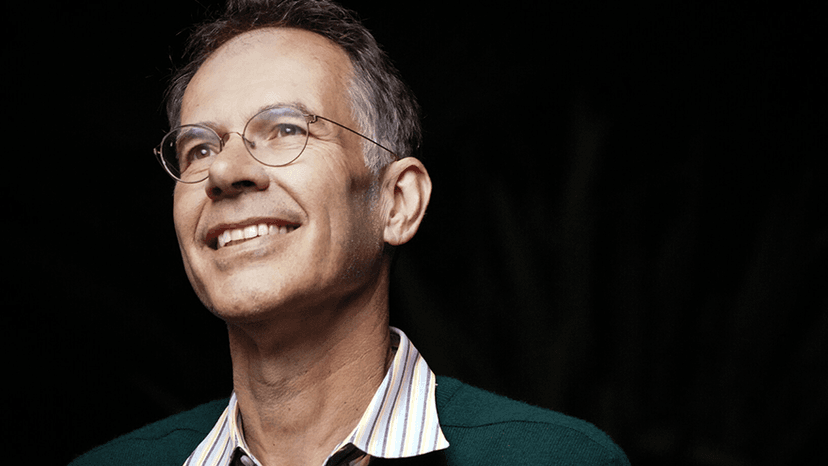
Guido Imbens, the Applied Econometrics Professor and Professor of Economics, receives the Nobel Prize in Economic Sciences.
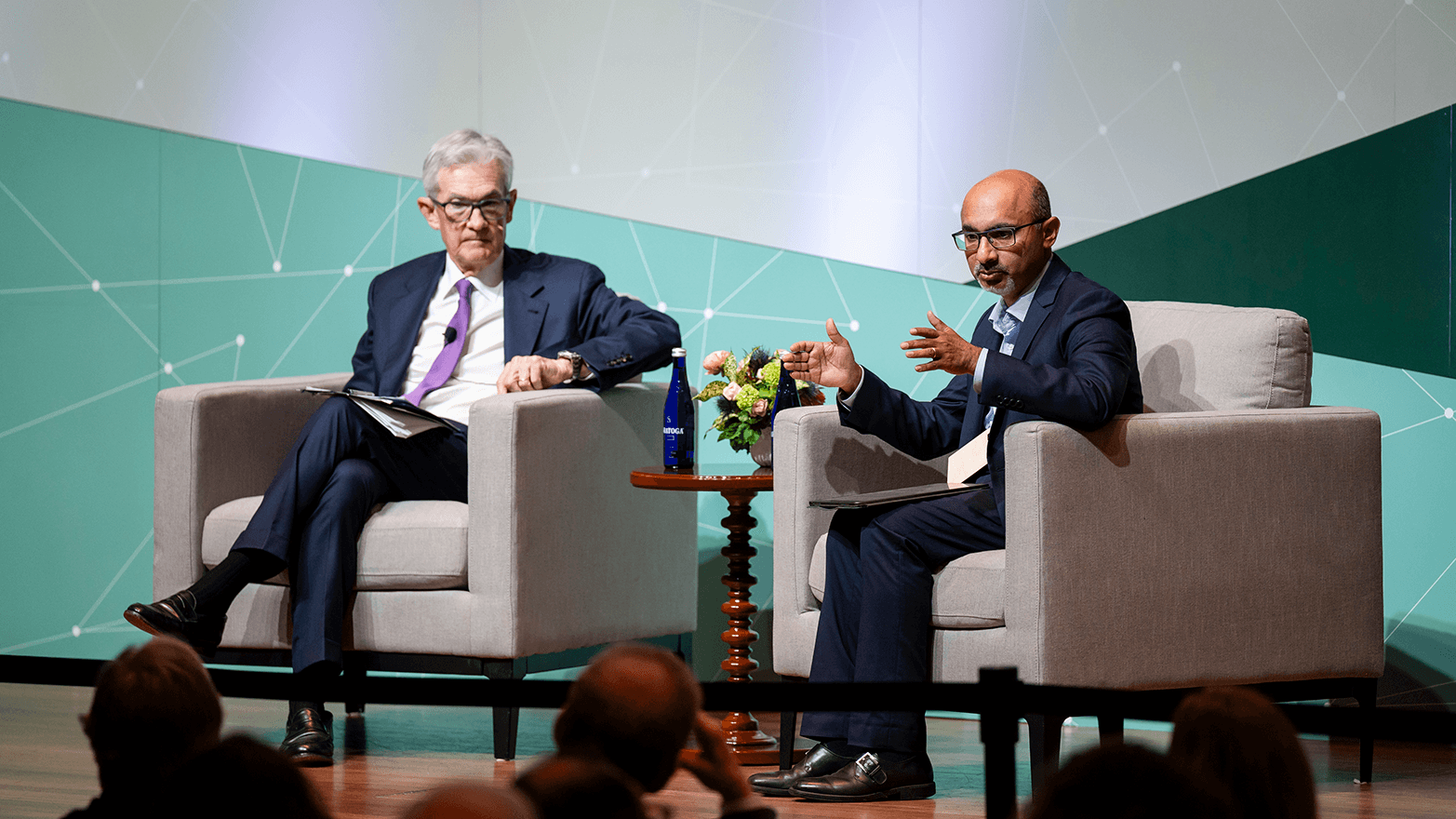
Stanford GSB launches the Business, Government & Society Initiative, a cross-disciplinary effort to explore current issues including technology, free markets, and sustainability.
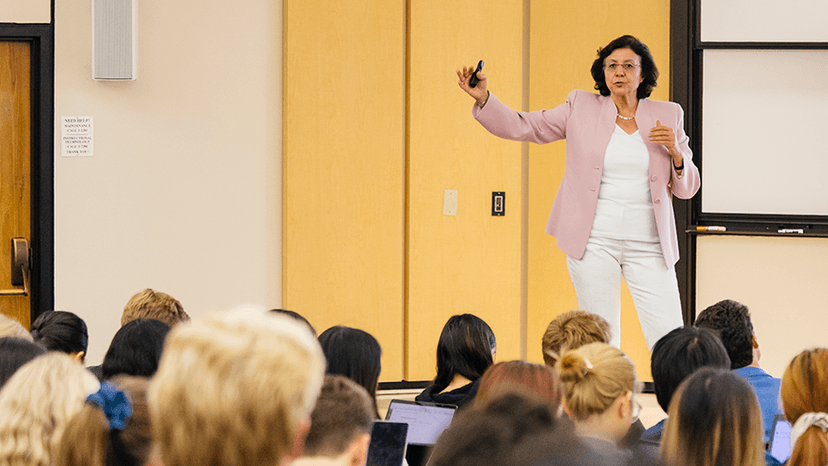
Stanford GSB launches the Initiative for Financial Decision-Making in collaboration with the Stanford Institute for Economic Policy Research and the Stanford Department of Economics.
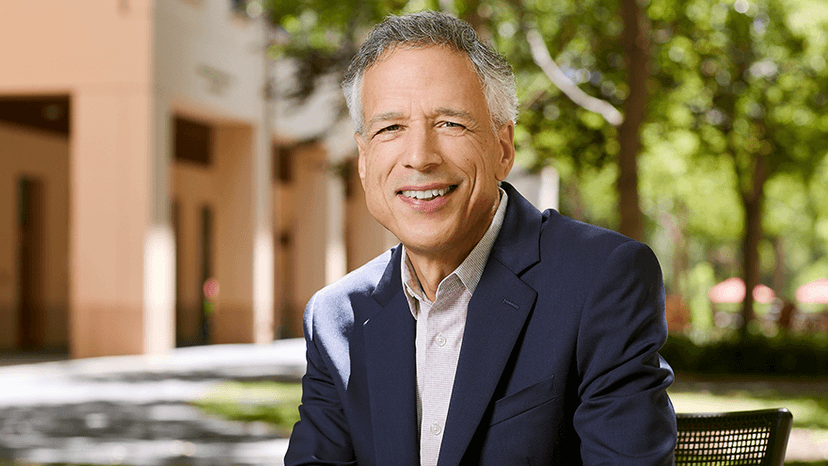
Peter DeMarzo, the John G. McDonald Professor of Finance, becomes interim dean when Jonathan Levin is named president of Stanford University.
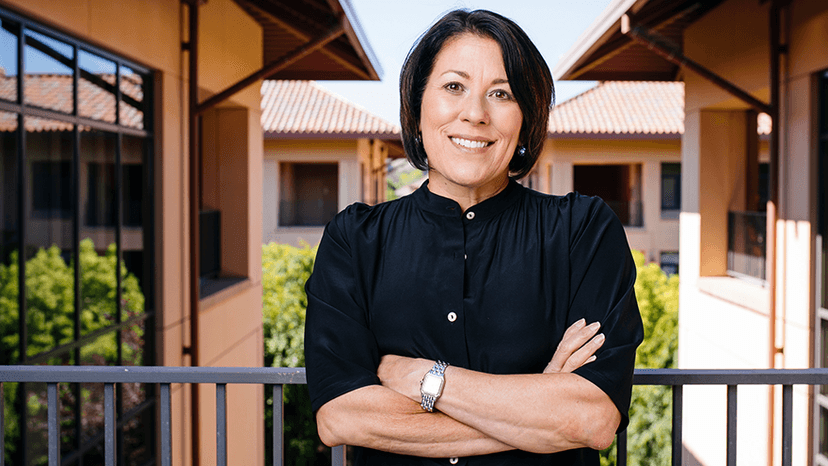
Sarah A. Soule, the Morgridge Professor of Organizational Behavior and the director of the Center for Advanced Study in the Behavioral Sciences, is named the eleventh dean of the GSB.
Stanford GSB celebrates its Centennial year.
80%
Percentage of GSB faculty who recently reported using AI in some form
38
Classes mention AI for MBAs and PhDs for 2025-2026.
Stanford GSB researchers get access to Marlowe, Stanford’s new “superpod” of 248 Nvidia H100 GPUs. A survey of faculty finds more than 80% are using AI in some form. Twenty-two courses mention AI or machine learning in their descriptions.
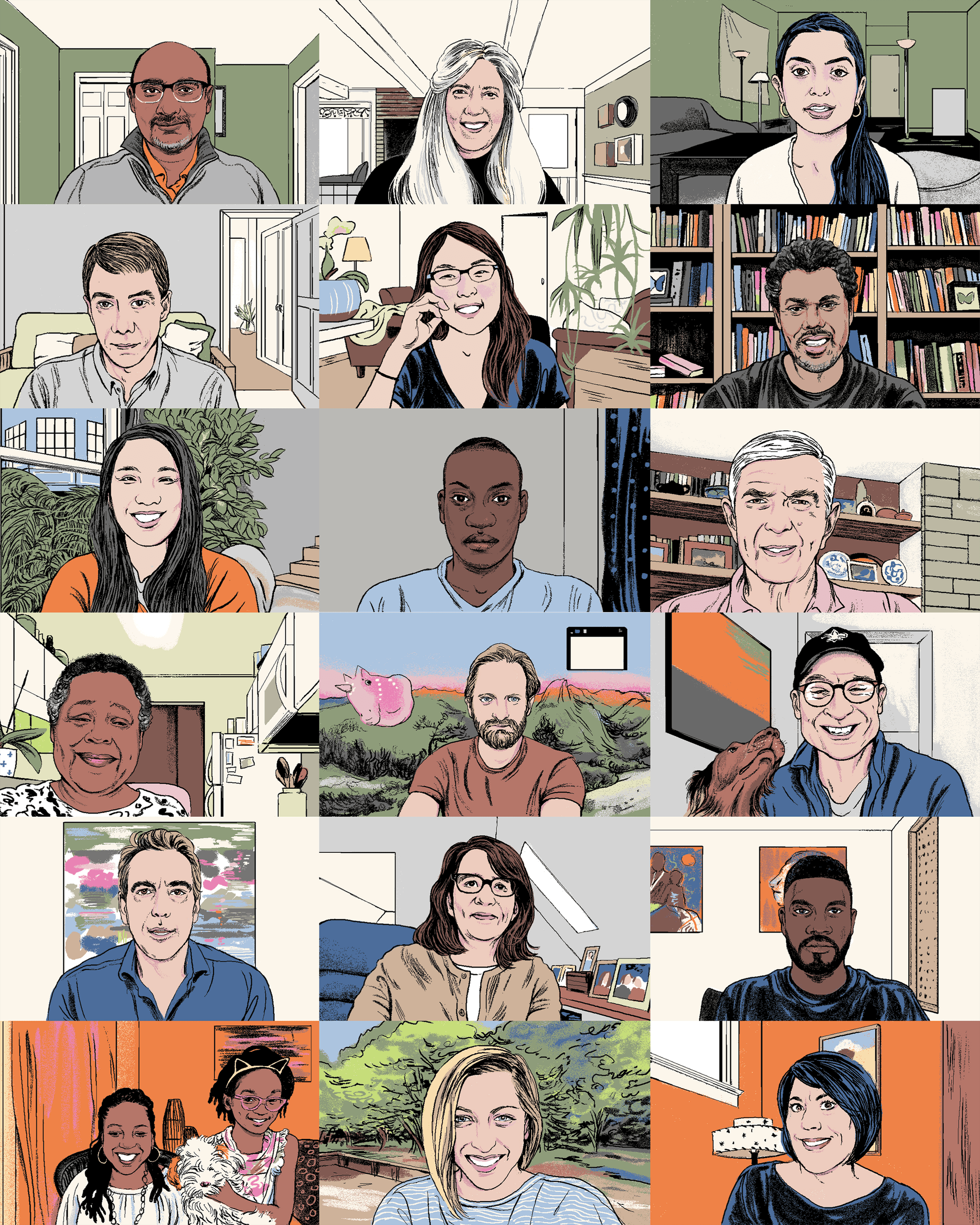
Zooming In
When COVID hit in March 2020 and the Stanford campus shut down, the GSB was relatively well poised to go digital: It already had an online business program (Stanford LEAD) as well as a team of experts in course design, digital content, and instructional technology. But many instructors had little to no experience with remote teaching and learning. Yet faculty and staff managed to move 90 courses online in just 60 hours.
Illustration by Agata Nowicka
A Memorable Day
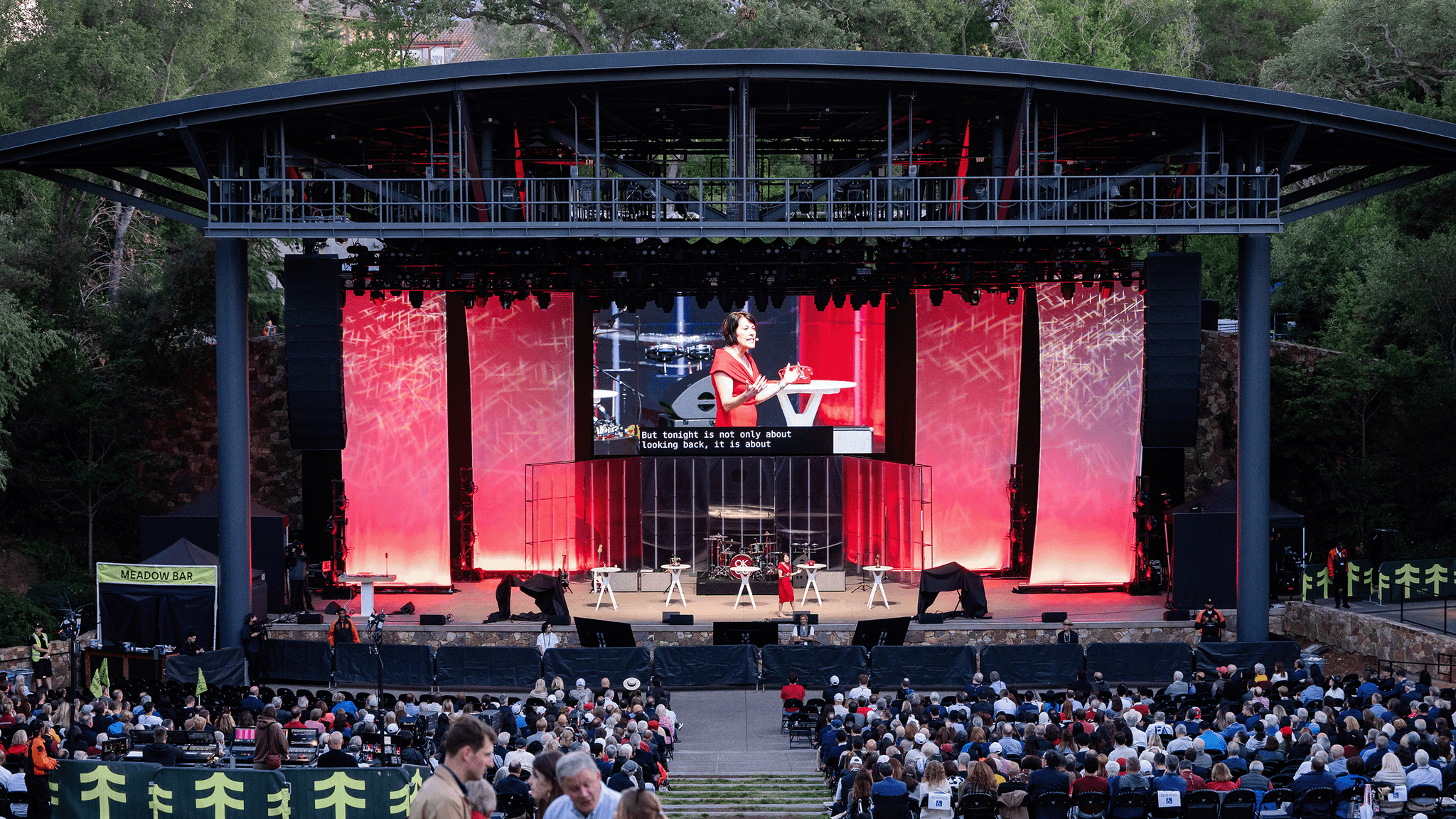
As evening fell, the iconic Frost Amphitheater came alive with an immersive, multi-sensory experience. Attendees explored interactive exhibits, heard remarks from Stanford President Jonathan Levin and GSB Dean Sarah A. Soule, listened to a special performance by the San Francisco Symphony, and enjoyed a concert by OK Go.